Background
Six years after the election of President Kais Saied, Tunisian public opinion has largely stabilized. Tunisians are navigating persistent economic hardship, a shrinking public sphere, and a regional landscape reshaped by the war in Gaza. Against this backdrop, the ninth wave of Arab Barometer surveyed Tunisians on their views of economic conditions, trust in institutions, government performance, migration, gender issues, the environment, democracy, and international affairs.
This factsheet highlights key findings from Arab Barometer’s public opinion survey in Tunisia.
How we did this survey
These findings are based on a nationally representative face-to-face survey conducted in Tunisia. The survey included 1,023 randomly selected citizens from across the country and was fielded from October 30 to November 30, 2025, using a multistage clustered sample. The margin of error for the reported results is ±3 percentage points. The survey is part of Arab Barometer’s ninth wave.
Economic Conditions, Government Performance, and Trust in Institutions
Confidence in the economy reaches its highest level since 2011, but economic concerns remain
- A plurality of Tunisians (44%) identify the economy as the country’s most important challenge. Among economic issues, inflation (42%) is viewed as the most pressing, ahead of unemployment (17%), poverty (15%), and low wages (13%).
- Three-in-ten (31%) rate the economy as good or very good, nearly triple the 11% recorded in 2023 and the highest level recorded by Arab Barometer in Tunisia since 2011. Two-thirds, however, still rate the economy as bad (33%) or very bad (35%).
- Optimism is on the rise: 56% believe the economy will improve in the next few years, with older Tunisians markedly more optimistic than younger Tunisians (60% vs. 42%).
Tunisians give the government higher marks on the economy.
- 38% say the government is doing a good job creating jobs, roughly double the 20% reported in 2023.
- 30% rate the government positively on narrowing the gap between rich and poor, up from 22% in, while 26% say it is doing a good job keeping prices down, double the 12% recorded in 2023.
- 44% of Tunisians express a great deal or quite a lot of trust in the government, up eight percentage points from 2023 and the highest level since the 2011 revolution. Older Tunisians are 13 points more likely than Tunisian youth to trust the government.
- Three-in-ten (30%) Tunisians believe civil society plays no role in the country, while trust in civil society organizations fell from 40% in 2023 to 35% in 2025. Yet Tunisian youth are more likely than those ages 30 and older to trust civil society organizations (49% vs. 32%).
Civic Engagement and Migration
Political engagement hits a new low
- Only 24% of Tunisians say they are interested in politics, the lowest level since 2011, and nearly half (48%) are “very uninterested.”
Economic pressures continue to fuel emigration aspirations
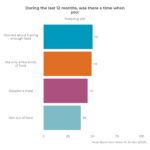
- Four-in-ten (41%) Tunisians want to emigrate, including two-thirds of Tunisian youth (67%) compared with a third (34%) of those aged 30 and older. Among potential migrants, 78% cite economic conditions as a reason for leaving.
Gender Issues
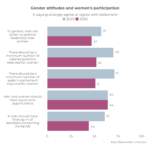
Tunisians back women in political leadership, even as traditional views on family roles rebound.
- 77% support minimum quotas for women in parliament and 79% support the same for cabinet positions, yet 54% believe men generally make better political leaders than women.
- After falling to a record low of 43% in 2021, the share saying a man should have the final say in all family matters rebounded to 57%, close to the 58% reported in 2016.
Democracy
Tunisians continue to support democracy, while prioritizing its outcomes
- Two-thirds (67%) say democracy is always preferable to any other form of government, largely unchanged since 2019.
- At the same time, 78% say the type of government does not matter as long as it can solve the country’s economic problems, and 64% say the same about maintaining order and security.
- Two-thirds (66%) say the country needs a strong leader willing to bend the rules to get things done, an 11-point drop from 77% in 2023.
- Asked to name democracy’s primary pillar, Tunisians most often cite providing basic necessities (29%), absence of corruption (21%), and equality under the law (21%). Just 5% identify free and fair elections. These findings suggest that Tunisians judge democracy on its outcomes more than its electoral processes.
Regional and International Affairs
The Gaza war reshapes attitudes toward the United States, Iran, and global powers.
- Roughly six-in-ten Tunisians describe the post-October 7 violence in Gaza as a genocide (31%) or massacre (29%).
- Only 23% hold a favorable view of the United States, down from 40% just before October 7, 2023. Three-in-five hold a very unfavorable view.
- Donald Trump is the least popular foreign leader, with just 14% rating his regional policies positively. Half of Tunisians say his policies are worse for the region than Joe Biden’s.
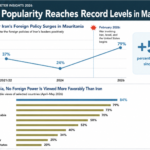
- Approval of the former supreme leader Ali Khamenei more than doubled, rising 29 percentage points from 20% in 2021 to 49% in 2025. Xi Jinping (61%) and Recep Tayyip Erdogan (55%) receive the highest ratings among foreign leaders.
- China is the most favorably viewed foreign power (69%), followed by Türkiye (67%), Germany (66%), France (58%), and Iran (55%). Israel ranks last at 3%.
📙Full Analysis: For additional results, graphs, and detailed breakdowns, please refer to the full report “Tunisia: Public Opinion Report 2025”.
Please credit Arab Barometer in any dissemination.
ENDS //
Arab Barometer Media Resources
For media inquiries, please contact Aseel Alayli, Director of Brand, Marketing, and Global Communications, at aalayli@princeton.edu.