Millions across the Middle East and North Africa (MENA) were already struggling with food insecurity before the current war, according to Mohamed Abufalgha, policy outreach manager at the U.S.-based research network Arab Barometer.
Rising prices and supply disruptions could worsen conditions, Abufalgha told Barlaman Today.
Arab Barometer published its new regional findings last week. The results of the latest report are based on surveys conducted from August to November 2025, a few months before the war involving the U.S., Israel, and Iran began.
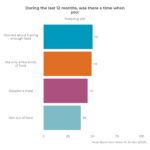
Arab Barometer’s findings noted that large shares of respondents in Egypt, Iraq, Jordan, Lebanon, Morocco, Palestine, Syria, and Tunisia reported trouble securing enough food. In six of the eight countries surveyed, at least half said they had run out of food and lacked money to buy more.
The findings already show “alarming levels of food insecurity across all surveyed countries,” Abufalgha said.
Many participants also expressed concern about having enough food due to financial issues, including 78% in Syria, followed by 60% in Tunisia, 59% in the West Bank and Egypt, 50% in Jordan, 33% in Morocco, and 28% in Lebanon.
“The war can only make matters worse for ordinary citizens as it causes spikes in transportation and food production costs,” he said.
Amid the current war, the Strait of Hormuz has been a focal point. Within days of the conflict, tanker traffic through the strait collapsed by more than 90%. The knock-on effects are a concern. “The disruption to food and fertilizer supply chains is also likely to result in rising food prices across the region,” Abufalgha explained.
As the data shows, large segments of the population are already struggling to access sufficient food supplies. “Any price increases will amplify these struggles, likely pushing more people closer to hunger,” Abufalgha highlighted.
Because the survey predates the conflict, conditions may already be worse than reflected in the findings. “The fact that the findings are from surveys conducted before the war means that the situation on the ground could actually be worse than these findings suggest,” he said.
Abufalgha said the surveys focused on eight countries instead of the full MENA region because the selected group offers a broad picture of shared regional risks. “The eight countries included in this wave reflect a diverse range of political and economic contexts, while capturing key structural vulnerabilities shared across many parts of the region, including high dependence on food imports and exposure to global price shocks.”
Food insecurity remains one of the region’s most pressing challenges. In Syria, 65% of respondents said their food did not last and they lacked the money to buy more, while Tunisia, Jordan, and Egypt reported similar rates between 61% and 62%. Morocco also showed significant strain at 56%.
Abufalgha noted that Gulf states also rely heavily on imported food, but many have stronger financial resources and social safety nets that can cushion immediate shocks. However, the findings still provide “important insight into how food insecurity is unfolding across a large and vulnerable segment of the region,” he said.
Read the original article at Barlaman Today