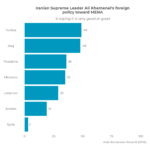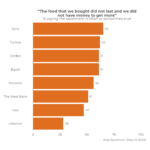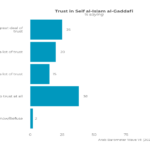
The Munich Security Conference (MSC) today released the Middle East Consultation Group (MECG) report at the opening of its 62nd annual conference (February 13–15), featuring Arab Barometer’s Wave IX public opinion findings. The report draws on nationally representative surveys conducted in Palestine, Israel, Lebanon, Syria, Egypt, Jordan, and Morocco to inform its analysis of regional cooperation and security, political transitions, governance reform, and conflict resolution.
The Wave IX surveys cited in the report were developed in partnership between Arab Barometer and the Munich Security Conference under the framework of the Middle East Consultation Group initiative, chaired by Ambassador Helga Maria Schmid, Vice President of the MSC Foundation Council. The report’s key takeaways will be discussed on February 14 during a dedicated session at the Munich Security Conference.
📙 The full MECG 2026 report “Building on Momentum: From Promise to Progress” is available here.
Below is a brief factsheet summarizing the Arab Barometer findings featured in the MECG report.
📊 Factsheet
Palestine & Israel : Wave IX | October 2025
Two-State Solution Remains the Preferred Path, While Israeli Opinion Divides Amid Support for the Trump Peace Plan
Key findings:
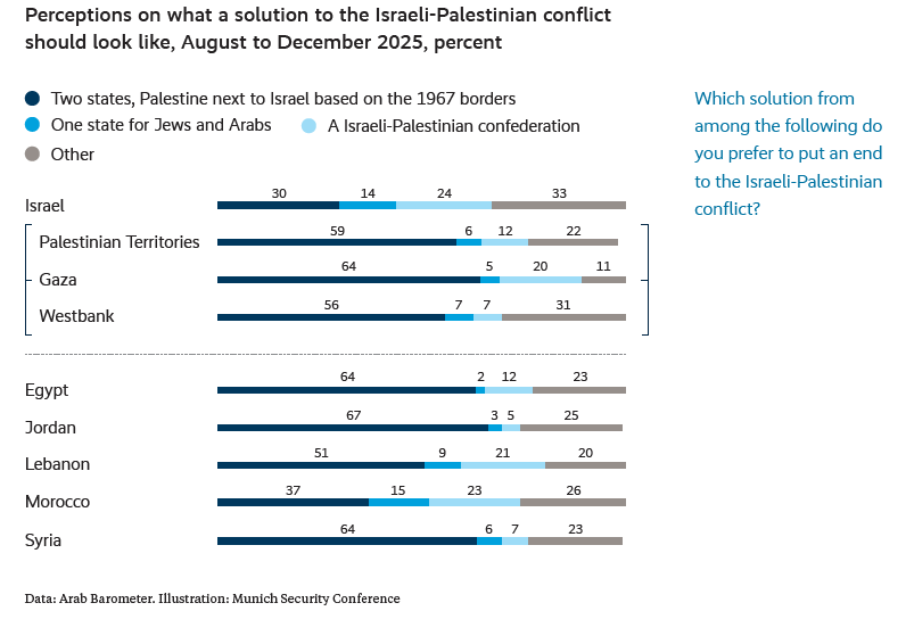
- 59% of Palestinians support “two states, Palestine next to Israel based on the 1967 borders,” including 64% in Gaza.Support for an Israeli-Palestinian confederation stands at 12% (21% in Gaza), while backing for a one-state model remains in the single digits.
- Across nearly all surveyed Arab countries, up to two-thirds favor a two-state solution. In Israel, 30% prefer two states, 24% a confederation, and 14% a single state for Jews and Arabs.
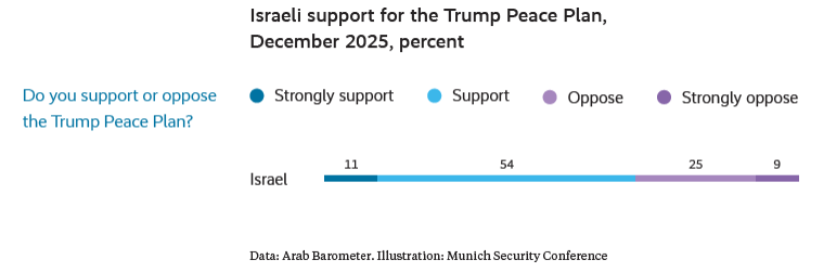
- Taken together, 71% of Palestinians and 54% of Israelis support a two-state outcome, whether confederated or not; at the same time, 65% of Israelis express support for the Trump Peace Plan.
Lebanon
Wave IX | November 2025
Post-Ceasefire Priorities: Sovereignty, Reconstruction, and Economic Reform
Key findings:
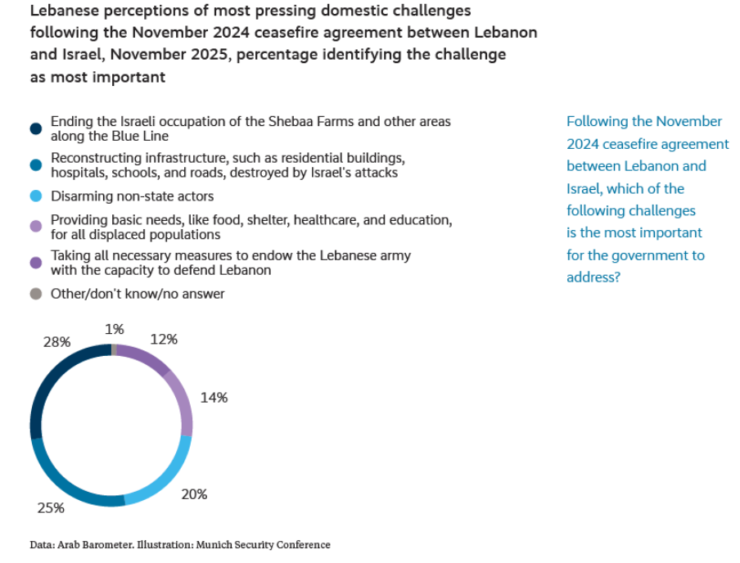
- 28% of Lebanese identify ending Israeli occupation along the Blue Line as the top challenge one year after the Lebanon-Israel ceasefire agreement, followed by reconstruction of damaged infrastructure (25%).
- Security-related concerns — disarming non-state actors (20%) and strengthening the Lebanese Army (12%) — rank below territorial and reconstruction priorities.
- In a separate question, 72% say economic reform should be the government’s foremost responsibility, highlighting that financial and governance recovery remains the central public demand.
Syria
Wave IX | October–November 2025
Strong Support for Political Transformation and Democratic Governance
Key findings:
- 76% of Syrians support the country’s political transformation one year after the fall of the Assad regime.
- 70% agree that democratic systems, despite their problems, are better than other forms of governance, and more than half reject the need for a leader who can bend the rules — signaling demand for accountable, rules-based leadership.
- While domestic support is strong, confidence in the Syrian President’s policies remains limited in some Arab countries; Jordan stands out, with 69% expressing a positive view of his leadership.
Regional Trends
Wave IX | 2025
Economic Anxiety Dominates Public Opinion Across the MENA Region
Key findings:
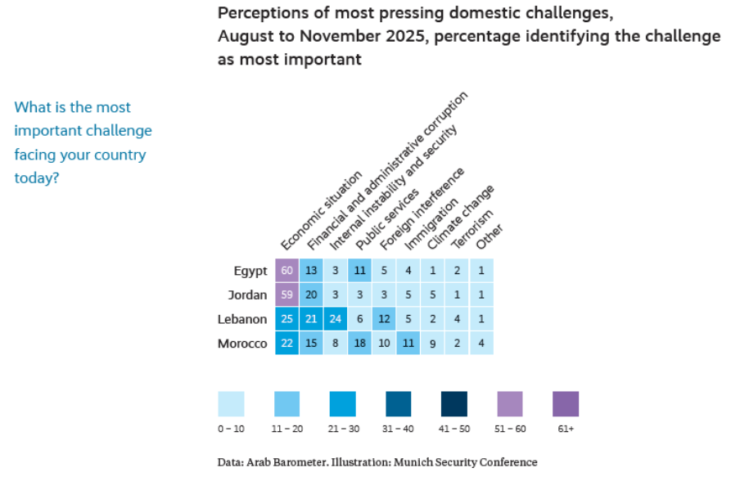
- Across surveyed MENA countries, citizens rank the economic situation as the most important challenge facing their country — cited by 60% in Egypt, 59% in Jordan, 25% in Lebanon, and 22% in Morocco.
- Corruption and governance problems rank as major secondary concerns, reflecting persistent distrust in state institutions.
Please credit Middle East Consultation Group at Munich Security Conference and Arab Barometer in any dissemination.
ENDS //
Arab Barometer Media Resources
For media inquiries, please contact Aseel Alayli, Director of Brand, Marketing, and Global Communications, at aalayli@princeton.edu.
• Website: www.arabbarometer.org
• Resources for Media: www.arabbarometer.org/media-news
• FAQ: www.arabbarometer.org/frequently-asked-questions
• About Arab Barometer: www.arabbarometer.org/about
• Methodology: www.arabbarometer.org/survey-data/methodology