Since the start of the U.S.-Israeli war with Iran, attention has focused largely on military escalation, regional security, and turmoil in global energy and commodity markets. Less attention has been paid to other potential consequences of the war, such as changing public opinion and the underlying frameworks through which regional and global actors are evaluated. With the recent signing of the MOU between the U.S. and Iran, examining such changes is particularly important to understanding the long-term consequences of this conflict.
New findings from Arab Barometer point to a dramatic surge in favorable attitudes toward Iran in Mauritania, a country geographically distant from the conflict and with few direct ties to Tehran. The scale of the shift is striking. Although few Mauritanians expressed positive views of Iran’s leadership’s foreign policies two years ago, today the vast majority hold favorable views of Iran and rate the foreign policies of its Supreme Leader positively. This result appears to mark a sharp acceleration of an ongoing trend already visible elsewhere in the region. By late 2025, Iran was already gaining support in several Arab countries, but the findings from Mauritania suggest that the U.S.-Israeli attacks on Iran may have dramatically accelerated that trend. While evidence from a single country cannot establish a broader regional shift on its own, the results raise important questions about how the conflict may be reshaping perceptions of legitimacy and foreign influence across the Arab world.
At the same time because Iran was already gaining ground in other countries, these new results raise important questions about how the conflict may be reshaping perceptions of the legitimacy of foreign powers across parts of the Arab world and possibly beyond. They also call into question a long-held assumption: that citizens in most countries in MENA have limited desire for closer engagement with Iran. If sustained, one long-term consequence of these events may be greater public openness to warmer relations with Iran, potentially narrowing one of the major political and sectarian divides in the broader MENA region.
These findings are based primarily on a new survey conducted in Mauritania from April 28 to May 12, 2026. Due to unforeseen circumstances, Arab Barometer’s survey in Mauritania was conducted about six months after the eight other surveys in the project’s Wave IX. As a result, Mauritania is the only country for which data are available after the start of the war with Iran.
Mauritania may not seem like the most obvious country for tracking public sentiment in the Arab region, but it offers an unusually revealing test case for how the war may be affecting publics that are geographically distant from Iran and not directly involved in the conflict. Mauritania is located more than 3,000 miles from Iran. There are no strong historical ties between the two countries and, although both are Islamic Republics, nearly all Mauritanians are Sunni while Iranians are overwhelmingly Shia. In short, there is very little linking the two countries. Mauritania has not been directly affected by the conflict, in part because it is effectively a continent removed from it. Yet, despite these realities, public opinion has been dramatically shaped by recent events.
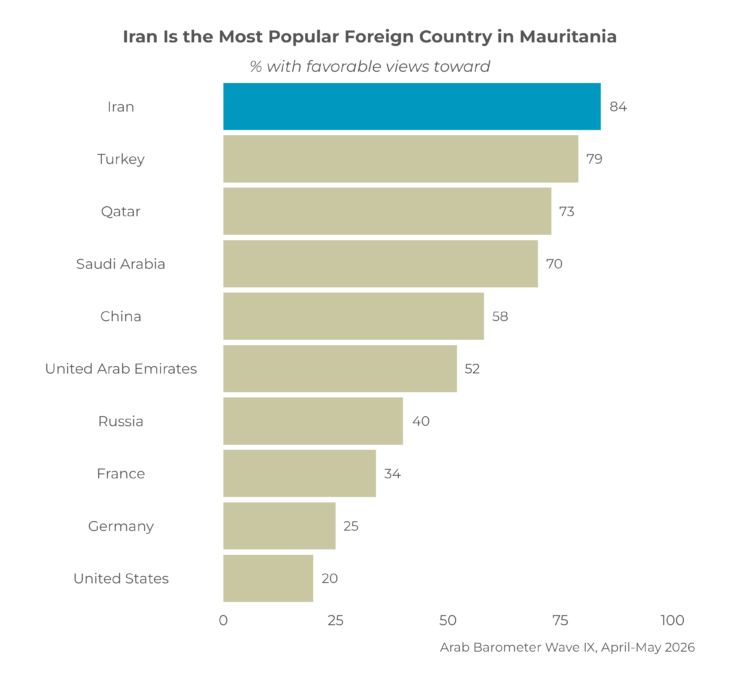
Today, views toward Iran are more favorable than views toward any other country included in the Mauritania survey questionnaire. Fully 84 percent of citizens have a favorable view of Iran. This exceeds the level for Turkey (79 percent), Qatar (73 percent), and Saudi Arabia (70 percent), three other predominantly Sunni countries, and is well above the UAE (52 percent). It is also far above the U.S. (20 percent), former colonial power France (34 percent), and Germany (25 percent). Notably, it is also far higher than the favorability of Iran’s primary allies, China (58 percent) and Russia (40 percent). In short, Iran’s popularity exceeds that of regional powers with which Mauritania has more in common, as well as Iran’s allies and its enemies. By this evidence, Iran appears to be gaining ground in the battle for public opinion, as many citizens seem to view it less as a regional threat than as a country under attack by far more powerful adversaries.
Unfortunately, Arab Barometer has never before directly asked about Iran’s popularity in Mauritania. However, a question on views of the foreign policies of Iran’s Supreme Leader shows a dramatic change in attitudes since two years prior. Today, 79 percent of Mauritanians rate the policies of Mojtaba Khamenei positively, compared with just 24 percent who said the same about the policies of Ali Khamenei in 2024—a jump of 55 points. Notably, Iran’s position on Gaza alone is unlikely to explain the scale of this shift: from the 2021-2022 survey to the 2024 survey, positive views of the Supreme Leader’s policies fell by 13 points, suggesting that Iran’s posture toward Gaza had not, by itself, produced a comparable improvement in public opinion in Mauritania. The most plausible explanation for the shift since 2024 is that the current war has generated substantial sympathy for Iran.
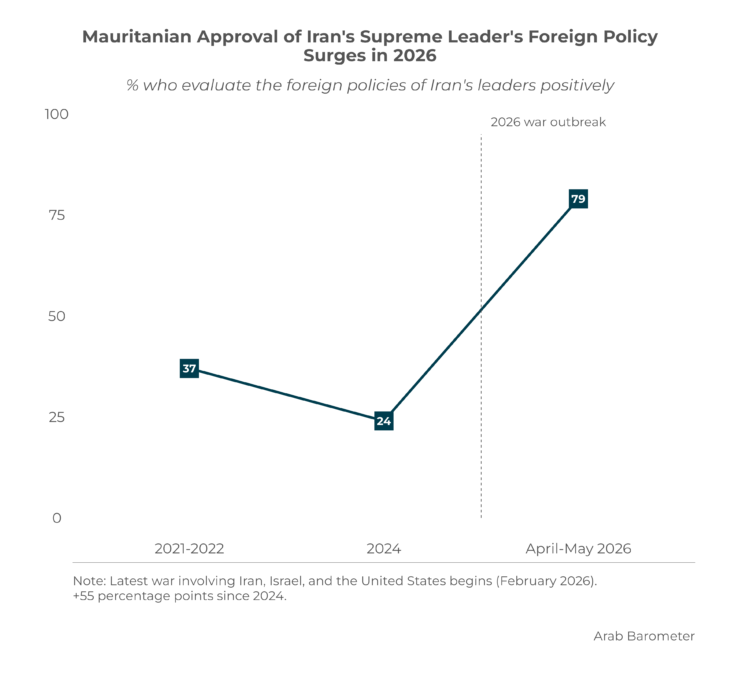
Results from Mauritania alone cannot determine if a similar shift occurred elsewhere, but there are multiple reasons to think that Mauritania is unlikely to be unique. Two years prior, Mauritanians’ attitudes toward Iran did not stand out. When asked to evaluate Khamenei’s foreign policies, Mauritania’s ratings were the median among eight countries surveyed, with 24 percent offering a positive rating. This was 13 points lower than Iraq, where support was highest, and 15 points above Kuwait, where support was lowest.
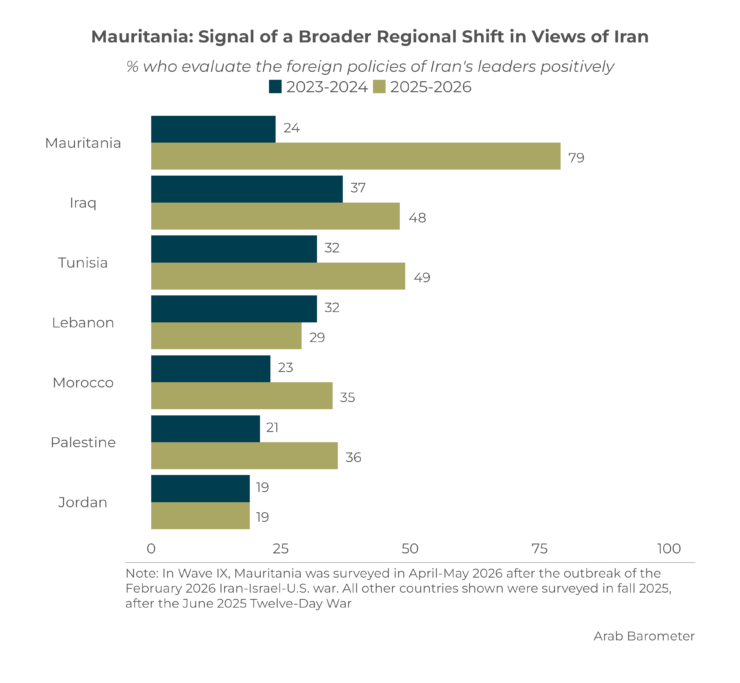
Among the seven countries surveyed by Arab Barometer where the same question was asked in fall 2025—a few months before the U.S. and Israel bombed Iran on February 28, 2026, but after the Twelve-Day War in June 2025—support for Iran’s foreign policies had increased to some extent in countries such as Tunisia (49 percent) and Iraq (48 percent). But support did not exceed half in any country surveyed. In this regard, Mauritania, surveyed after the outbreak of hostilities in February 2026, stands out dramatically from the countries surveyed in 2025: it rates Iran’s foreign policy 30 points higher than any other country surveyed across the region. It is possible that Mauritania has become an outlier. But given its earlier position in the middle of the pack, it is more plausible that Mauritania is revealing at least part of a broader shift that has not yet been measured elsewhere.
Yet in other ways, Mauritania does not stand entirely apart. In recent years, positive ratings of the foreign policies of Iran’s leaders had been increasing. Compared with surveys conducted in 2023-2024, positive ratings had increased by 17 points in Tunisia, 15 points in Palestine, 12 points in Morocco, and 11 points in Iraq by late 2025. Only in Jordan and Lebanon was there effectively no change, although in both countries current ratings are higher than in surveys conducted five years ago. In short, support for the foreign policies of Khamenei had been increasing in several countries across MENA even before the 2026 war, meaning only the size of the increase in Mauritania makes it stand out.
What, then, do Mauritanians appear to favor about Iran? The data suggest that growing sympathy for Iran does not necessarily translate into support for Iranian regional influence, its nuclear program, or its political system. Many Mauritanians continue to express concerns about aspects of Iranian power and remain strongly supportive of democratic governance. Rather than signaling support for Iran’s domestic model, the findings appear to reflect changing perceptions of Iran’s role in the current conflict and of the legitimacy of the actions taken against it. In this sense, the shift may say less about admiration for Iran itself than about how many Mauritanians are evaluating the broader regional confrontation.
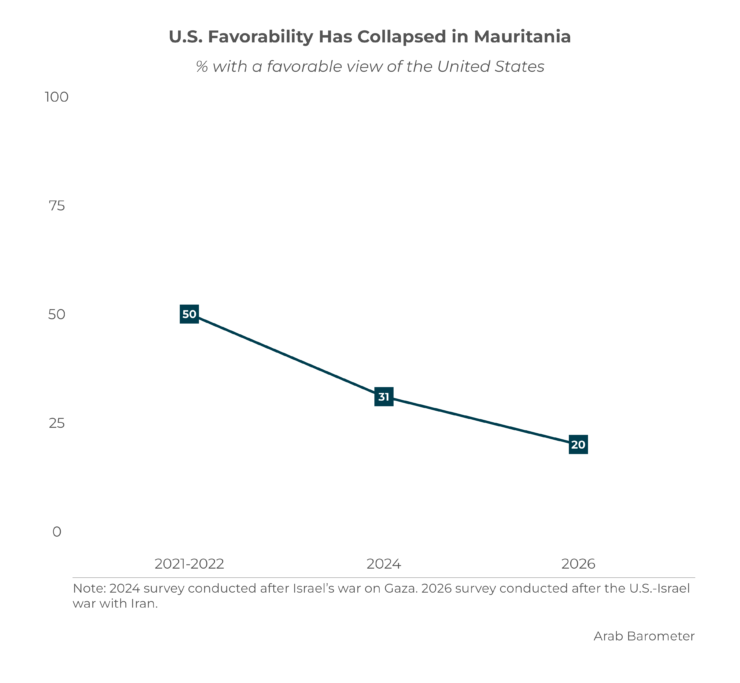
Ultimately, the timing and magnitude of the shift point strongly to the 2026 war as the central driver. Israel is deeply unpopular in Mauritania, with only four percent holding a positive view. Although the U.S. was relatively popular in 2021-2022, when half of citizens held a favorable opinion, that level has plummeted. As in many other MENA countries, support for the U.S. dropped dramatically in the aftermath of Israel’s war on Gaza, falling by 19 points to 31 percent in 2024. However, despite the U.S.-brokered 20-point Gaza peace plan and the resulting ceasefire in Gaza, ratings of the U.S. have fallen by a further 11 points to just 20 percent today.
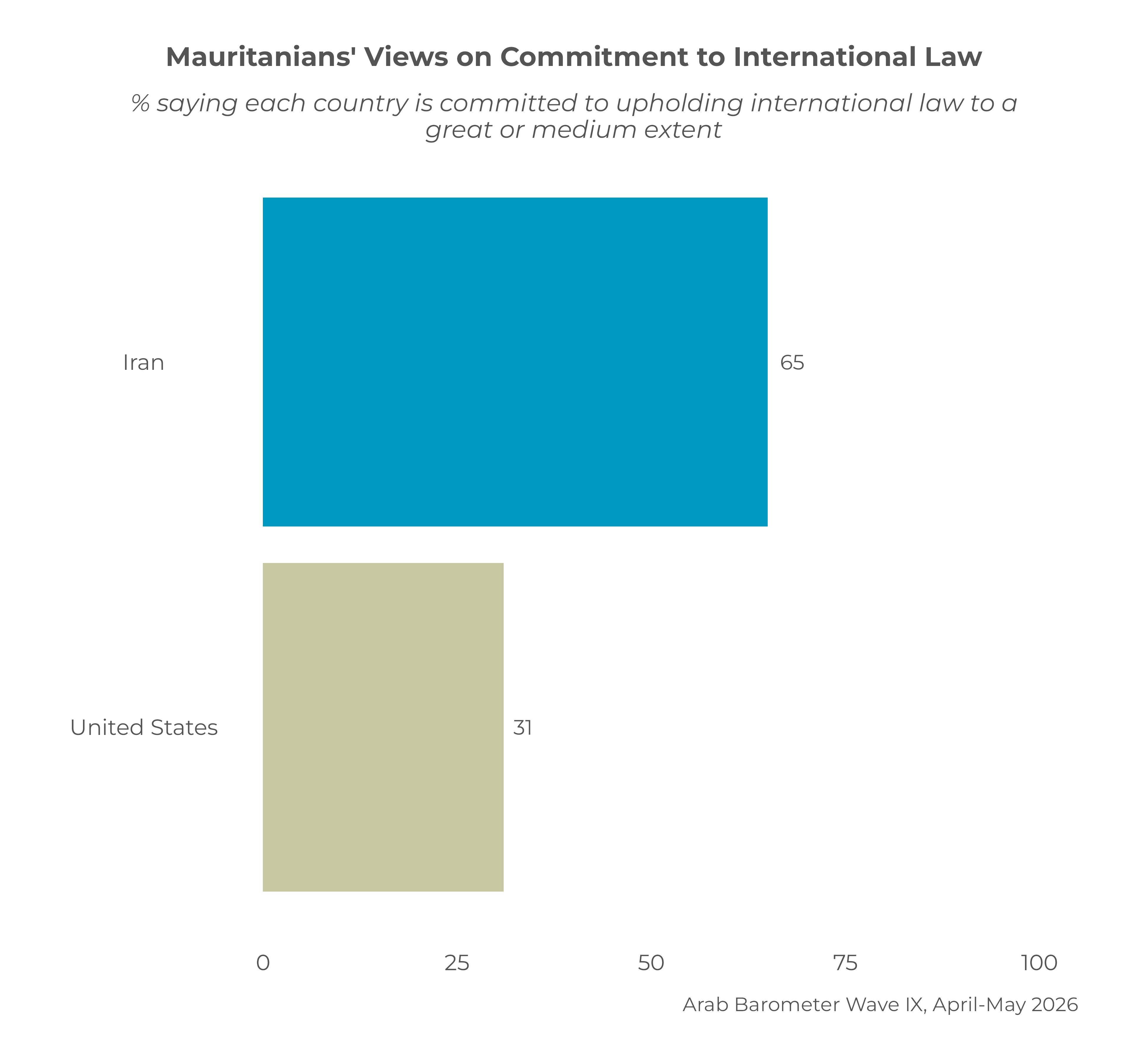
Perceptions of commitment to upholding international law also support this interpretation. Although the U.S. has long claimed to support a rules-based order, just 31 percent of Mauritanians believe the U.S. is committed to upholding international law to a great or medium extent. In contrast, 65 percent say that Iran is committed to upholding international law.
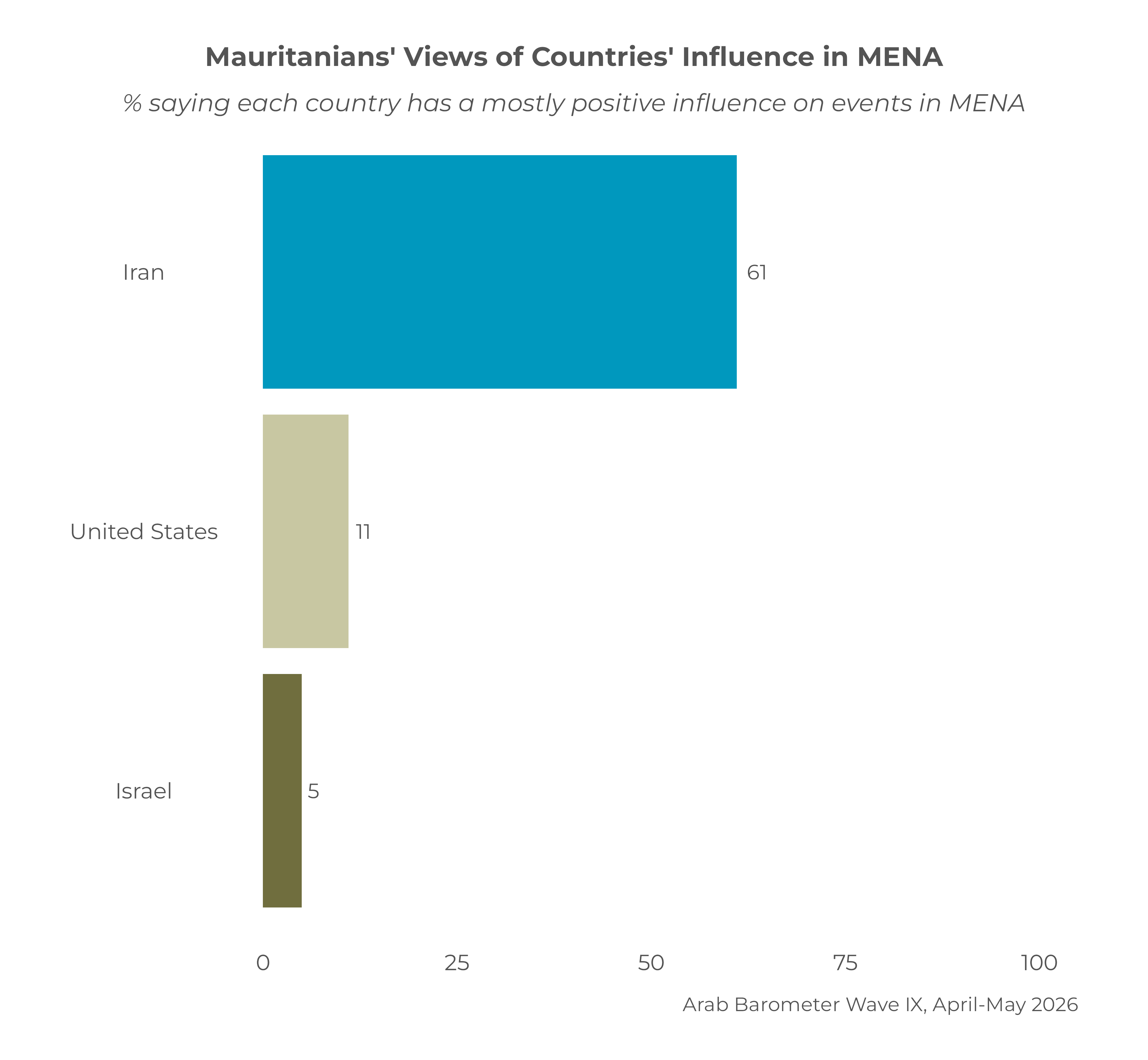
Other findings point in the same direction. Just 11 percent of Mauritanians believe that the U.S. has a mostly positive influence on events in the Middle East and North Africa, while five percent say the same about Israel. When asked about Iran, 61 percent state that it has a positive influence on events in the region.
To date, Arab Barometer can measure the magnitude of these postwar changes in only one country, but the results are a potential harbinger. At the very least, Mauritania provides the clearest available survey-based signal of what may be happening elsewhere in the Arab region, even if comparable survey data are not yet available.
For decades, support for Iran and its foreign policies among the region’s populations has been relatively low, limiting calls for broader engagement with the Islamic Republic. If Iran now comes to be seen as a symbol of resistance to American and Israeli aggression, publics across parts of the region may become more open to engagement with Tehran and less receptive to American efforts to isolate it.
This challenge is compounded by low ratings of U.S. credibility on questions of international law. To the extent that publics see the U.S. as applying international law selectively, American and Israeli efforts to portray Iran as a uniquely rogue actor are likely to become less persuasive to global publics.
Whether Mauritania ultimately proves to be a harbinger or an outlier remains to be seen. But it provides the first available evidence of how the war may be affecting public opinion in the Arab world—and the early indications suggest that one of the conflict’s most important consequences may be a substantial increase in Iran’s regional legitimacy.
Explore the Infographic: Changing Views of Iran After the 2026 War