West Bank governance under scrutiny; Gaza public seeks alternative leadership
Two years after the war on Gaza began, Palestinian public opinion reflects a society deeply altered. The latest Arab Barometer survey (AB IX), conducted in the West Bank and Gaza Strip between October 8–26, 2025, finds a shift in concerns from economic growth to basic survival needs, falling satisfaction with governance, rising political engagement, and growing uncertainty about the future.
Public attitudes reveal a series of tensions: commitment to democracy alongside rising support for strong leadership; increased political interest amid declining confidence in civil liberties; and widespread frustration with existing leadership. Fatah’s support has eroded sharply, Hamas has largely maintained its base, and political alienation has become the dominant stance. At the same time, social norms have moved in a more conservative direction.
This first report focuses on governance and internal political dynamics, primarily in the West Bank. Due to war conditions, findings from Gaza in this release are limited to trust in political and humanitarian institutions. Subsequent Arab Barometer reports will examine Gaza conditions in greater depth, as well as public attitudes toward peace prospects and foreign relations.
Key Storylines & Findings:
From growth to survival: War reshapes priorities in the West Bank
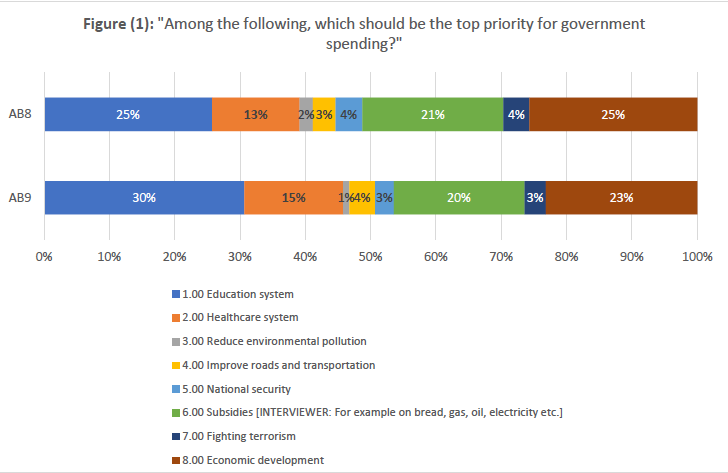
- Basic needs eclipse economic growth. Before the Gaza war, in 2023, economic development was the top concern in the West Bank (25%). By 2025, priorities had shifted: education rose from 25% to 30%, overtaking the economy, while health gained from 13% to 15%, reflecting a growing focus on immediate survival and social needs.
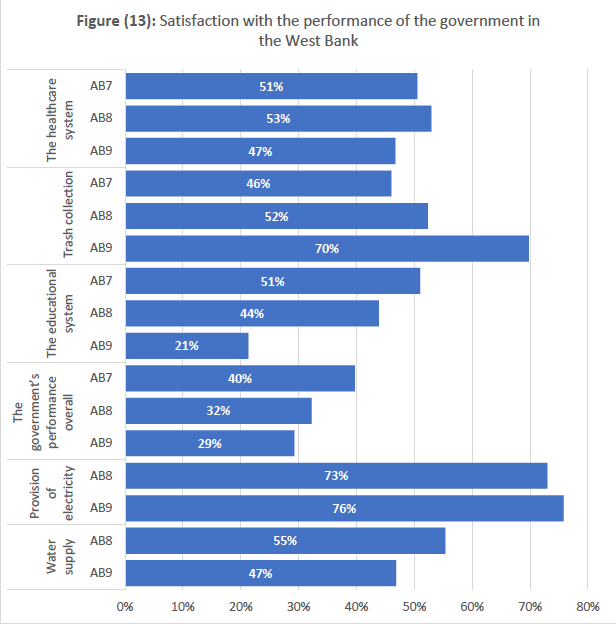
- Rising needs, falling satisfaction. As education and health became urgent concerns, satisfaction with government performance in these sectors dropped: education system fell sharply from 44% in 2023 to 21% in 2025, healthcare from 53% to 47%, and overall government performance slightly from 32% to 29%, highlighting a widening gap between public needs and state capacity.
- Persistent pessimism and exit pressure. Confidence in the PA on unemployment (13%), inflation (11%), and narrowing inequality (14%) remains low, while desire to emigrate ticked up slightly from 21% in 2023 to 24% in 2025, driven by economic (71%), security (38%), and politics (37%).
Governance paradox: Democratic ideals endure, confidence in practice erodes
- Political engagement rises amid crisis, but civil liberties remain fragile. The Gaza war spurred a rise in political interest in the West Bank, increasing from 29% in 2023 to 39% in 2025. At the same time, confidence in basic freedoms has declined sharply: only 16% now believe freedom of expression is guaranteed, down from 27% in 2023, and just 13% say the same for the right to protest, compared with 25% two years earlier. While a cautious majority still favors gradual reform, support for faster, more decisive action has grown from 32% to 38%.
- Democracy in principle, strong leadership in practice. Among Palestinians in the West Bank, support for democracy as the best system remains stable at 60%, yet backing for a strong leader who can ensure stability—even at democracy’s expense—rose from 41% in 2023 to 51% in 2025. At the same time, 68% say the type of political system matters less than the government’s ability to solve economic problems. Views of Western democracies have also worsened: positive ratings of American democracy fell from 57% to 42%, and of German democracy from 56% to 42%, reflecting growing skepticism about democracy’s effectiveness in times of crisis.
Political realignment driven by Fatah’s collapse and widespread alienation, not Hamas expansion
Fatah’s collapse and fragmented electoral support
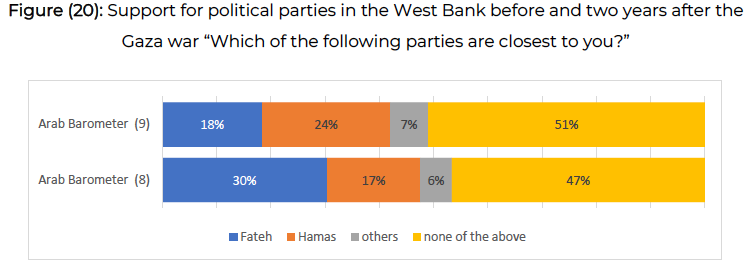
- Factional identification and electoral support show a sharp decline for Fatah. In 2023, Fatah was the most widely preferred faction in the West Bank, but by 2025 it had fallen behind Hamas. Hamas now ranks first at 24%, up from 17% before the war, while Fatah declined sharply to 18%, down from 30%. Smaller factions remain unchanged at 7%. The largest group, however, is politically alienated: over half of the population (51%) say they do not identify with any faction.
- Hypothetical legislative election results mirror these patterns. Fatah’s voter base nearly halved in the West Bank, falling from 23% before the war in 2023 to 14% in 2025. Hamas’s support nearly doubled in the West Bank, rising from 9% to 17% and remained stable in Gaza at 22%, reinforcing its status as a persistent political actor rather than an expanding one. Nonparticipation remains high, with 47% in the West Bank and 32% in Gaza saying they would not vote.
West Bank: Political trust divided as confidence in civil society and police rises
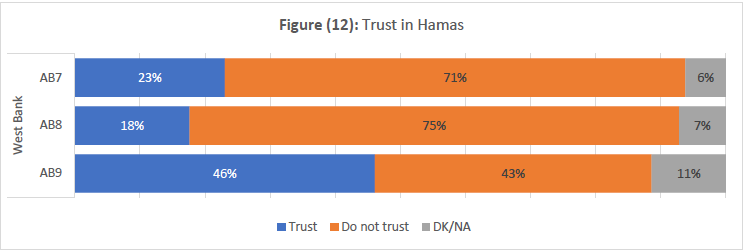
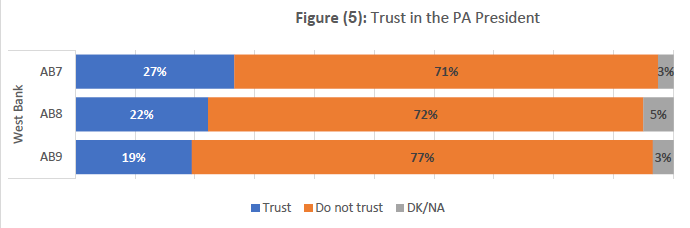
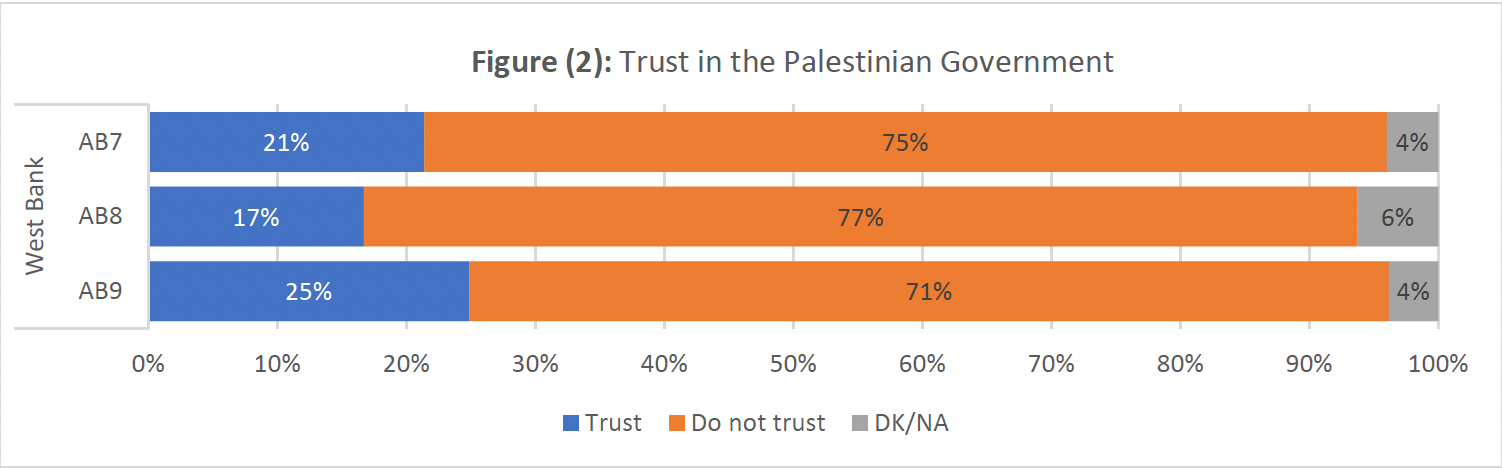
- PA trust remains weak as Hamas confidence surges. In the West Bank, trust in the Palestinian Authority government remains low at 23%, up slightly from 19% in 2023, reflecting a limited “rally around the flag” effect during the war. Distrust of President Mahmoud Abbas remains high at 77% (up five points). By contrast, trust in Hamas jumped sharply from 18% to 46%, but this increase did not translate into broader electoral support (17%).
- Trust increased across non-political actors. In the West Bank, confidence in the Palestinian police increased notably to 47% (from 38%), while trust in the National Security Forces reached 39% (from 34%)- distrust remains higher for NSFs, reflecting perceptions that they are less effective against Israeli settlers. Trust in the courts rose to 34% (from 27%) and in religious leaders to 25% (up six points). Trust in civil society organizations increased by 11 points, reaching 38%.
Gazans looks to alternative leadership as humanitarian trust outpaces political institutions:
Hamas maintains base, but humanitarian actors inspire higher public confidence
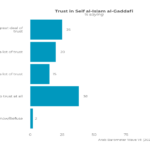
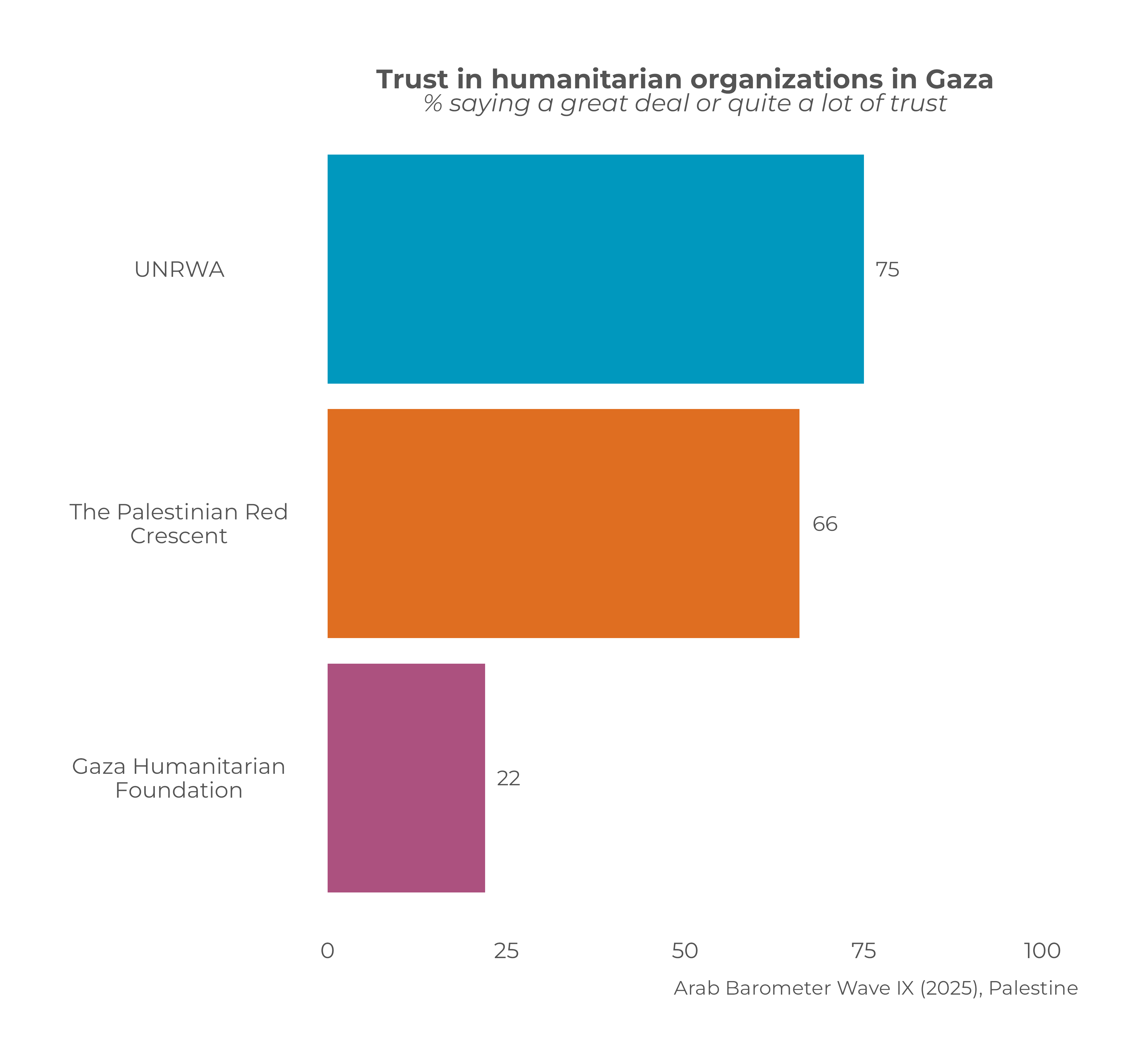
- Trust in political authorities in Gaza remains limited, with only 32% of residents saying they trust the Hamas government. By contrast, humanitarian organizations receive far higher confidence, with 75% trusting UNRWA and 66% the Red Crescent, underscoring the population’s reliance on relief actors during the war. Far fewer—just 22%—trust the Gaza Humanitarian Foundation.
Barghouti remains preferred president, reflecting demand for alternative leadership
- In hypothetical presidential elections in Gaza, imprisoned Fatah leader Marwan Barghouti leads with 30% of the vote, ahead of Hamas’s Khaled Mishal at 22% and President Mahmoud Abbas at 13%. These results are largely unchanged from 2023, confirming that the public seeks a leader who can transcend the failed models of both the PA and Hamas. Notably, 34% of respondents say they would not participate in such an election.
Social retrenchment: Crisis fuels a turn toward traditional norms in the West Bank
- Rising support for traditional gender roles. Amid prolonged crisis and persistently high religiosity, public support for traditional gender norms among West Bankers has increased. In 2025, 75% of Palestinians in the West Bank say men are better suited to political leadership, up from 63% in 2023. The share who believe men should have the final say in family decisions also rose, from 44% to 57%. These shifts suggest the war is reshaping not only political attitudes but also social norms, potentially reversing earlier gains in gender equality and constraining women’s long-term participation in public life.
📙 Full Analysis: Read the comprehensive Palestine report by Dr. Khalil Shikaki, Director at Palestinian Center for Policy and Survey Research.
Please credit Arab Barometer in any dissemination.
ENDS //
Arab Barometer Media Resources
For media inquiries, please contact Aseel Alayli, Director of Brand, Marketing, and Global Communications, at aalayli@princeton.edu.
• Website: www.arabbarometer.org
• Resources for Media: www.arabbarometer.org/media-news
• FAQ: www.arabbarometer.org/frequently-asked-questions
• About Arab Barometer: www.arabbarometer.org/about
• Methodology: www.arabbarometer.org/survey-data/methodology