As citizens across the Middle East and North Africa (MENA) region welcome the holy month of Ramadan, concerns over economic conditions and food insecurity loom large. In 2022, Arab Barometer reported on the pervasiveness of food insecurity in several countries across the region. Four years later, little has changed for ordinary citizens. Indeed, prolonged economic struggles, coupled with conflict and rising global inflation have deepened existing vulnerabilities.
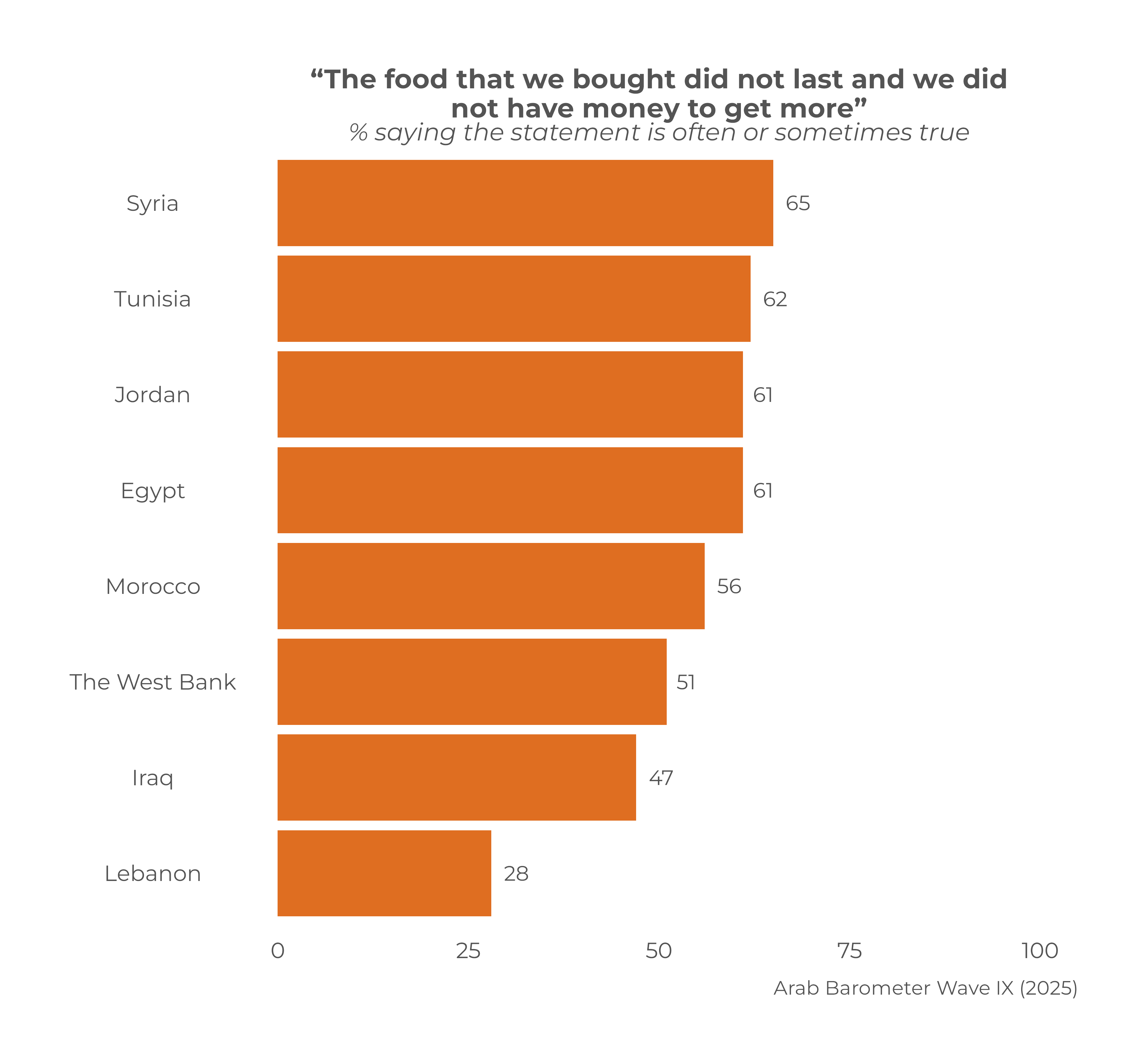
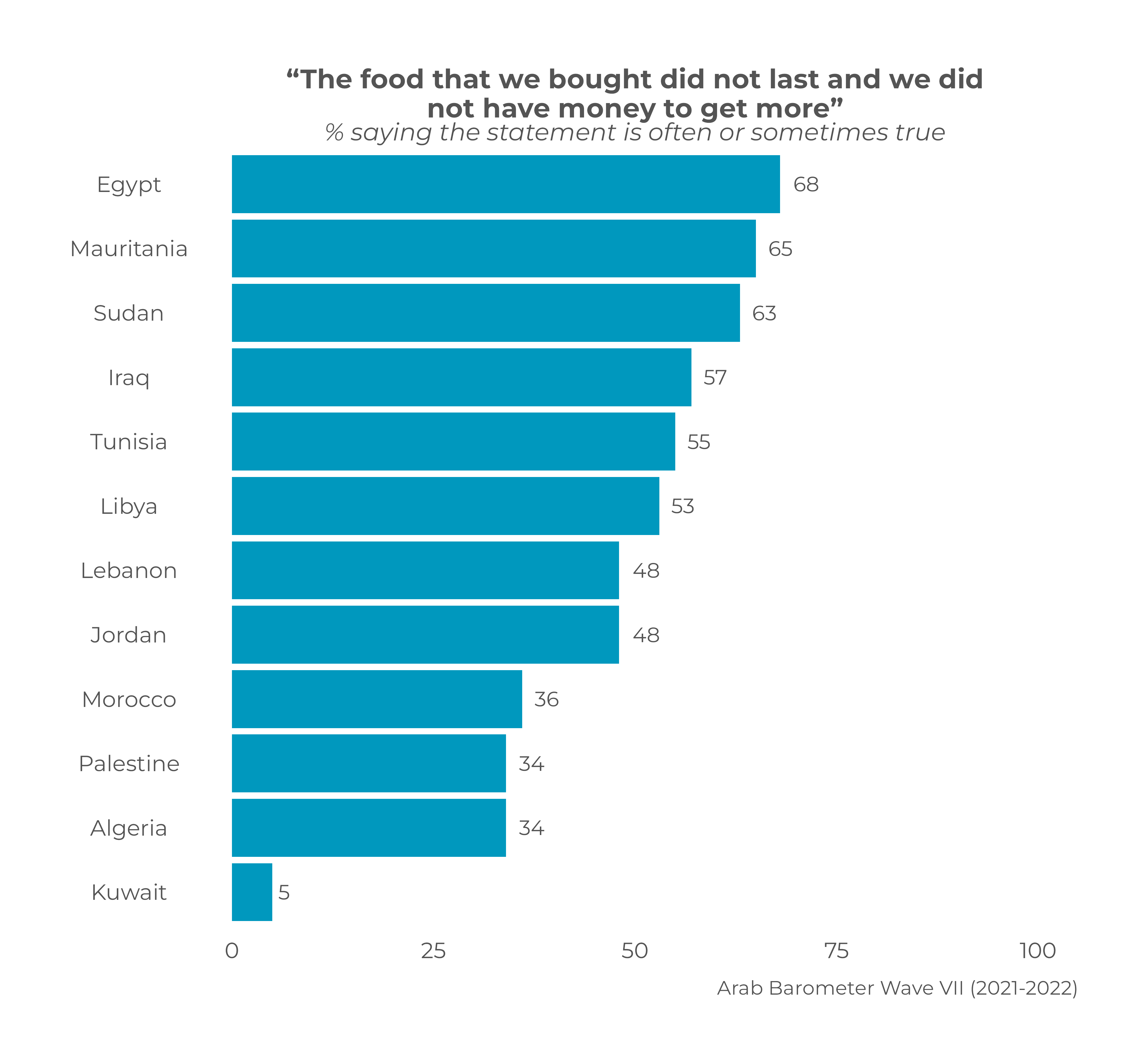
Findings from Arab Barometer’s Wave IX survey in 2025 paint a grim picture of food insecurity ahead of Ramadan. In six of eight countries surveyed, at least half report running out of food without having the means to resupply in a timely manner. About two thirds (65 percent) in Syria say this has often or sometimes been the case, as do roughly six-in-ten in Tunisia (62 percent), Jordan (61 percent), and Egypt (61 percent). This is also the experience of at least half in Morocco (56 percent) and the West Bank in Palestine (51 percent). Only in Iraq (47 percent) and Lebanon (28 percent) is this a less common phenomenon, but the numbers remain troubling.
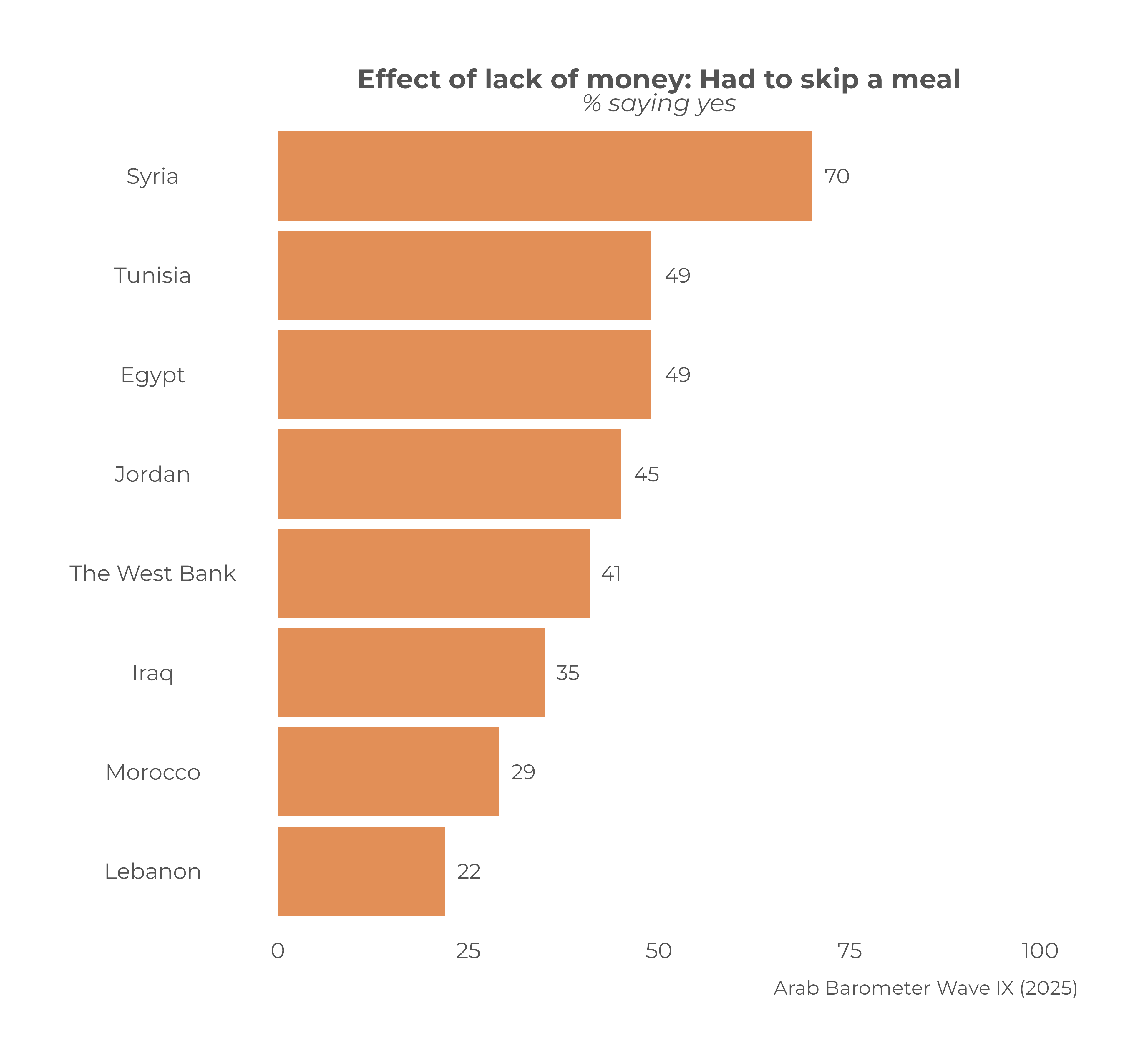
Even grimmer are the proportions of those who report actually having to skip meals due to lack of resources. Seven-in-ten in Syria say they had to skip a meal for financial reasons. Half of Tunisians (49 percent) and Egyptians (49 percent) say the same along with 45 percent of Jordanians and 41 percent of Palestinians in the West Bank. Ramadan is meant to cultivate empathy for the less fortunate and to practice abstinence; yet, foregoing meals is becoming routine at other times of the year for millions across the region.
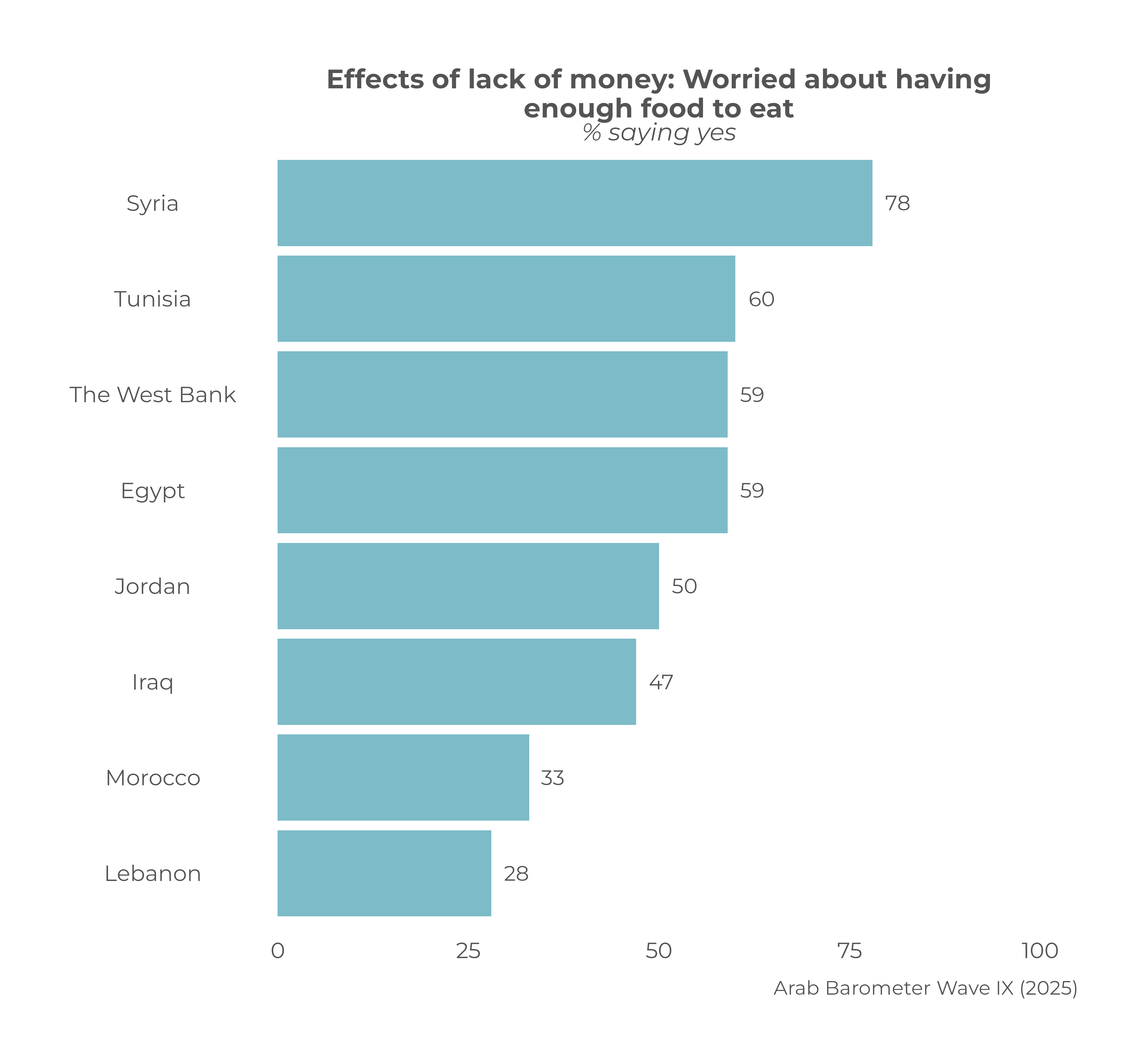
Concerns about securing adequate food supplies are widespread. Roughly four-in-five Syrians (78 percent) say they are worried about having enough food due to lack of financial means. Three-in-five Tunisians, Palestinians in the West Bank (59 percent), and Egyptians (59 percent) say the same. Significant proportions of people in the remaining countries express similar concerns, including half in Jordan, 47 percent in Iraq, a third in Morocco, and 28 percent in Lebanon. These findings suggest that, for many across the region, Ramadan not only serves as a spiritual time, but may also come with additional economic burdens.
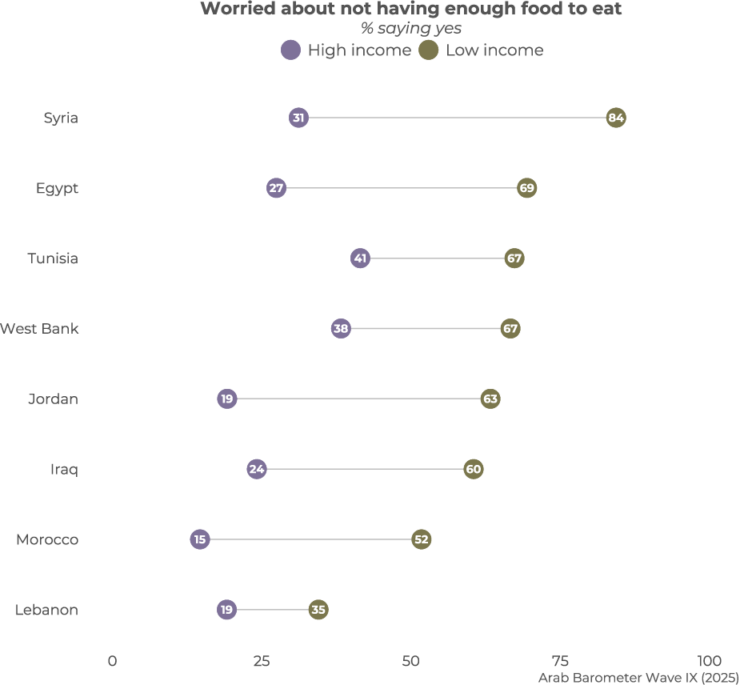
Unsurprisingly, this stress is not shared uniformly. Food insecurity and anxiety about securing supplies vary sharply by levels of income. Those who cannot cover their expenses are more likely to report running out of food, to skip meals, or to express concern over supplies than their better-off counterparts. This income-based gap in concerns over having enough food to eat is the largest in Syria with a margin of 53 points. Even in Lebanon where the gap is smallest, poorer Lebanese are roughly twice as likely to express concern than their better-off counterparts (35 percent vs. 19 percent). These inequalities are only likely to magnify during Ramadan.
Such strains are further exacerbated by rising inflation, which is seen by many citizens as a key challenge. Pluralities in Egypt (45 percent), Tunisia (42 percent), and Syria (31 percent) point to inflation as the most serious economic issue facing their country. This sentiment is shared by a quarter in Lebanon (26 percent) and a fifth in the West Bank, Jordan, and Morocco (18 percent). Prices often increase ahead of Ramadan, which will likely only add to the stress families already feel.
Moreover, citizens make clear that government efforts to control this inflation are falling short of people’s expectations. Only in Morocco does roughly half (47 percent) of the population express satisfaction with the government’s performance in keeping prices down. In all other surveyed countries, no more than a third rate the performance positively. In Lebanon, a mere two percent say the government is doing a good job in controlling prices. For many across the region, economic hardship is compounded by eroding confidence in the state’s ability to improve economic conditions.
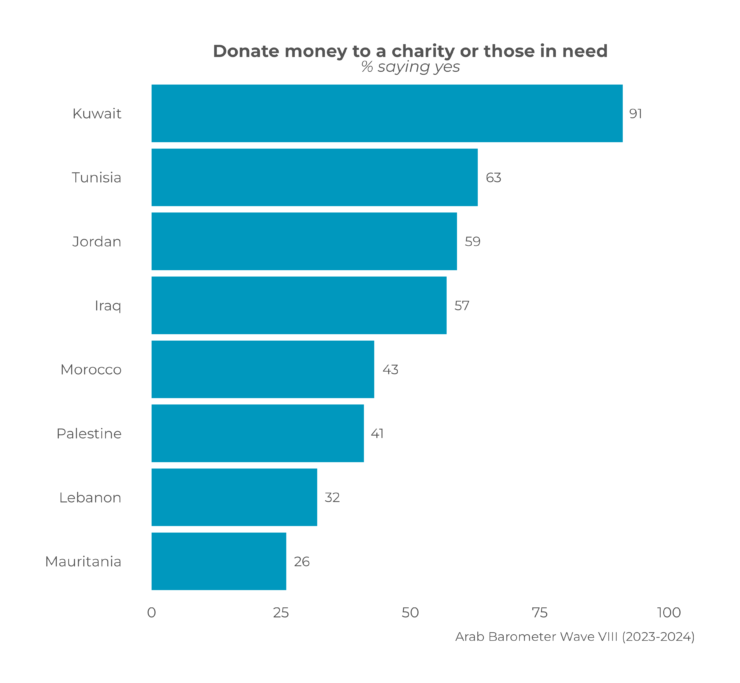
Ramadan is often framed, rightly so, as a month of solidarity, generosity, and social unity. Yet, the data suggests a more complicated and stressful reality at the micro level. Findings from Arab Barometer’s Wave VIII (2023-2024) show significant proportions of people in all countries surveyed donating to charities or those in need on monthly basis. Such generous acts typically surge during Ramadan. Yet, while charity -Zakat or others- and family networks may ease the struggle of some families temporarily, these measures cannot substitute for effective social protection systems and sustainable government policies to help those in need. The findings from Arab Barometer Wave IX reveal that the struggle to secure food is no longer an individual issue, it is an issue of governance and state performance and that is a challenge throughout the year.
As millions across the region observe the holy month, the challenge they face is not abstinence, but deprivation. For many households, the question this Ramadan is not what to prepare for Iftar, but whether there will be enough food on the table at all.