Leaders of great powers, rising powers, and regional players have long shaped the global geopolitical landscape. In the Arab world, their actions are followed closely. The region’s rich resources and growing investment opportunities make it a key arena for influence and competition.
The latest Arab Barometer survey (September 2023–July 2024) shows how citizens across the Arab world view the foreign policies of major global leaders toward the region. This analysis reveals that when people view a leader’s policies positively, they are more likely to support stronger economic ties with that country, and less likely when they view them negatively.
How Do Arabs View Leaders’ Foreign Policy Toward the Region?
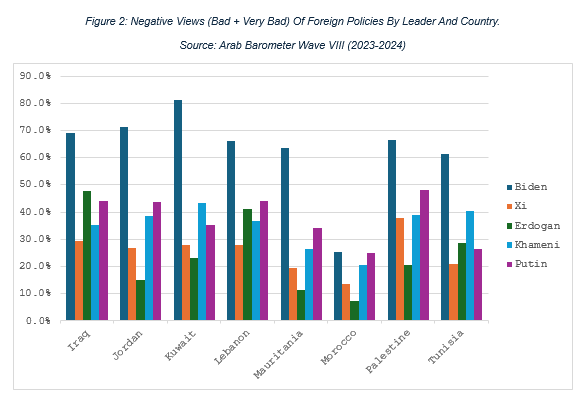
As Figure 2 shows that in all surveyed countries, at least six-in-ten view former President Joe Biden’s foreign policy toward the region negatively. This perception reflects a combination of long-term and more recent factors, including the U.S. involvement in the Iraq War, its strong military interference, and its stance on the Israel–Palestine conflict. During the 2023 Gaza war, over 80 percent of the Arab population viewed the U.S. role as negative, in a different survey conducted during the Israeli offensive on Gaza between 2023-2024.
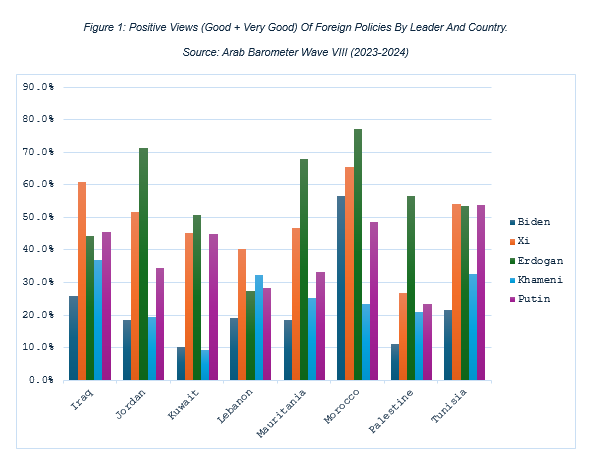
In contrast, as Figure 1 and 2 show, Chinese President Xi Jinping, who took office in 2013, receives much more favorable ratings. This variation in views reflects differences in each leader’s administrative approach to the region. The policies of President Xi focus on investment and development initiatives, such as the Belt and Road Initiative, signing strategic partnerships, and promoting peace, as demonstrated by China’s mediation role in the reconciliation between Saudi Arabia and Iran in March 2023.
China’s focus on economic and technological development and investments in the Arab region resonate with Arab Publics. In most countries surveyed, fewer than 30 percent rated China’s foreign policy as negative, while over 45 percent viewed it positively, except in Palestine (surveyed before October 7, 2023), where citizens tend to view all leaders negatively.
President Recep Tayyip Erdoğan of Turkey stands out for his strong and vocal support for Palestine and his consistent criticism of Israeli policies. His popularity is especially high in Palestine and Jordan, the two countries most directly affected by the Palestinian issue. Erdoğan’s blend of moderate Sunni Islamic identity, anti-Western stance and outspoken stance toward Israel has made him one of the most positively viewed leaders in the Arab world.
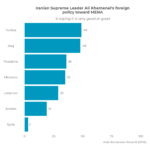
On the other hand, Iranian Supreme Leader Ali Khamenei is viewed less favorably. His foreign policy receives more negative than positive ratings in most Arab countries, with Tunisia being a rare exception, which has maintained a more neutral stance toward Iran compared to other Arab states.
Uniquely, Russian President Vladimir Putin’s foreign policy toward the region receives mixed reviews. Despite Russia’s involvement in the Syrian conflict, many in the region still view Putin’s foreign policy toward the region positively, possibly because they see it as a counterweight to the West, and appreciate its UN positions aligning with Arab causes, particularly Palestine.
Arab Views on Leaders’ Foreign Policy Correlate with Economic Preferences
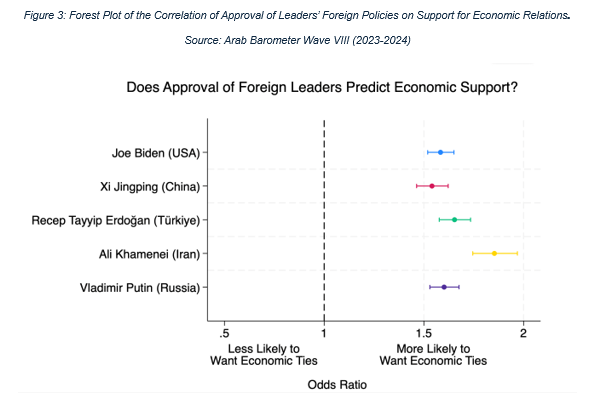
These views are not just symbolic; they are correlated with real economic preferences. Statistical analysis of the Arab Barometer data shows a strong correlation between how people view a leader’s foreign policy and their willingness to support economic cooperation with that leader’s country.
As seen in Figure 3, across all surveyed Arab countries, people who favor a foreign leader’s policy to the region, are much more likely to support stronger economic ties with that leader’s country. This pattern holds across the U.S., China, Russia, Turkey, and Iran. In other words, the results show that when people view a leader’s foreign policies positively toward their region, they are more open to trade, investment, and economic partnerships with that leader’s country. When they don’t, they prefer the economic relations to be weaker.
Therefore, Arab public opinion matters, as there is a correlation between public opinion of leader’s policies toward the Arab region and people’s preference for economic relations with that country. Thus, for leaders of rising or competing powers looking to expand their acceptance and economic relations in the Arab region, adopting foreign policies that foster peace, economic development, respect for sovereignty, and reflect shared interests could reflect positively. A foreign policy that centers on destabilizing the region, acting unilaterally, or being dismissive of Arab concerns reduces the enthusiasm for economic engagement for the people.
Dana Abu-Haltam is a Political Science PhD Candidate at the University of Tennessee, Knoxville. The views expressed in this piece are her own.