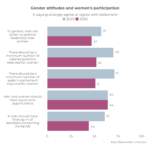
Women’s exclusion from the workforce in the Middle East and North Africa (MENA) is a substantial problem. The Middle East has the world’s lowest rates of female labor froce participation — 26 perecent compared to 54 percent worldwide (USAID 2014) — and a gender gap in youth unemployment — 43 percent for females and 25 percent for males (Barnes 2013). Serious problems arise as a result. Low women’s workforce participation has been identified as a cause of political disempowerment (Norris and Inglehart 2001; Ross 2008), slow economic growth (World Bank 2013), and authoritarian persistence (Fish 2002; Inglehart and Norris 2003a).
Visit External Site