As the war involving the United States, Israel, and Iran escalates into a broader regional confrontation, new Arab Barometer survey data offer critical insight into how publics across the Middle East and North Africa are reassessing regional security, alignments, and the influence of great powers.
These themes were at the center of the Washington launch of Arab Barometer’s Wave IX surveys, convened on March 31, 2026, by the Princeton School of Public and International Affairs DC Center in collaboration with Arab Barometer, New Lines Institute, and the University of Michigan.
Panelists Dean Amaney Jamal, Khalil Shikaki, Robert Malley, and Michael Robbins, moderated by Razia Iqbal, examined two central themes: Palestinian public opinion after two years of war in Gaza, and shifting regional views and great power competition amid escalating conflict.
Key regional insights from the discussion include:
- Erosion of Western legitimacy: MENA publics increasingly view the United States and key European allies as one-sided and selectively committed to international law, contributing to a broader loss of credibility.
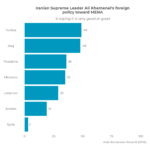
- Rising acceptance of alternative powers: China, Russia, and Iran are gaining ground in perceived legitimacy, though MENA publics are not uniformly supportive. Concerns remain about Iran’s regional role and nuclear ambitions, while Russia and China do not command universal admiration.
- Gaza as the defining lens: The war in Gaza continues to shape political judgments across the region. Many Arab citizens rank Israel’s occupation of Palestinian territories and actions in Gaza as a more urgent threat than Iran; this shapes how external actors are judged and reinforces low ratings of Western actors that are aligned with Israel.
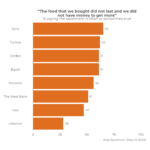
- Crisis of credibility on core principles: Across key measures, including upholding international law, protecting rights and freedoms, contributing to regional security, and advancing the Palestinian cause, Western policies are widely seen as falling short. This perceived inconsistency is driving a broader loss of legitimacy and has accelerated a shift in political credibility.
- Conditional normalization and pathways to engagement: Support for normalization with Israel remains low across the region but increases significantly if tied to the recognition of the State of Palestine. At the same time, MENA citizens show sustained backing for a two-state solution and overwhelming support for reconstruction efforts in Gaza, highlighting conditional openness to engagement anchored in Palestinian statehood and post-war recovery.
- Policy choices matter: The case of France, where favorability has rebounded following its official recognition of the State of Palestine, illustrates how even largely symbolic, principle-based policy shifts can meaningfully improve public perceptions and help restore credibility.
- Shifting perceptions driven by policy choices: With public confidence in Western actors deeply eroded, rebuilding legitimacy will require credible shifts in policy toward the region, alongside consistent alignment with core principles such as international law, freedoms, and security.
Key insights on Palestinian public opinion after two years of war in Gaza:
- Between principle and pragmatism: Despite the scale of the war, Palestinian public opinion shows movement toward more pragmatic positions, including increased support for a two-state solution and conditional openness to normalization tied to the recognition of a Palestinian state and guarantees of dignity and rights.
- Diverging experiences, shared national goals: Populations in Gaza and the West Bank, having experienced radically different wars, are developing distinct political orientations that future Palestinian leadership must reconcile. Gazans are showing greater openness to compromise and West Bankers are maintaining harder-line positions. Yet both populations remain aligned on core issues, including opposition to occupation and support for Palestinian statehood.
- Between domestic priorities and conflict resolution: While the conflict remains central, immediate economic survival—jobs, food security, basic services—increasingly dominates public concerns, creating pressure on leadership to deliver material improvements regardless of political breakthroughs.
- Crisis of governance and demand for alternatives: Political support is fragmenting, with Fatah’s backing collapsing, Hamas maintaining its base, and political alienation becoming the dominant stance. At the same time, there is a clear public search for new leadership that can move beyond the limitations of both the Palestinian Authority and Hamas, with imprisoned Fatah leader Marwan Barghouti emerging as a leading preference.
About Arab Barometer Wave IX Surveys
These findings are based on eight nationally representative surveys conducted across the Middle East and North Africa as part of Arab Barometer’s Wave IX (2025), drawing on more than 10,000 face-to-face interviews. The margin of sampling error is ±3 percentage points or less in each country.
Fieldwork was conducted in the following countries and periods: Morocco (Aug. 23–Sept. 6, 2025); Egypt (Sept. 11–25, 2025); Iraq (Sept. 28–Nov. 2, 2025); Jordan (Oct. 1–12, 2025); Palestine—West Bank (Oct. 8–26, 2025) and Gaza (Oct. 8–15, 2025); Syria (Oct. 29–Nov. 17, 2025); Tunisia (Oct. 30–Nov. 30, 2025); and Lebanon (Nov. 3–25, 2025).
More details on Arab Barometer’s Wave IX surveys and related outputs are available here.
Watch & Explore the Data
Watch the full panel discussion for expert analysis and in-depth perspectives on public opinion across the Middle East and North Africa.
📊 Explore the event presentation for detailed survey findings and country-level data on regional public views of security, alignments, and global powers.
📄 Dive deeper into Palestinian public opinion after two years of war in Gaza with this concise factsheet and two accompanying reports:
Palestine Report #1: Palestinian Perceptions of Governance and Domestic Power Balance