
Wars in Gaza, Iran, and Elsewhere Have Sunk Washington’s Reputation—Maybe for Good
Practically every person in the Middle East has been affected by the chain of events put into motion by Hamas’s October 7, 2023, attack on Israel. Tens of thousands of people, mostly Gazans, have been killed, millions have been displaced, and billions of dollars in damage has been inflicted. It’s not surprising, then, that the perspective of tens of millions of people has shifted.
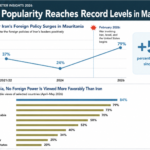
Polling by Arab Barometer, a survey project that we co-lead with others, conducted in the months after October 7 showed a sea change in public opinion. As ordinary people in the region witnessed Israel’s devastating war in Gaza, they turned sharply against Israel and the country’s biggest ally, the United States. And surveys we conducted in Egypt, Iraq, Jordan, Lebanon, Morocco, the Palestinian territories, Syria, and Tunisia from August to November 2025—after the 12-day war last June but before the latest round of fighting with Iran—make clear that the changes observed in the aftermath of October 7 have stuck. People in the region have lost nearly all confidence in a U.S.-led regional order. Instead, on the whole, they now regard China, Iran, and Russia more favorably than the United States and, often, Europe. More than ever, Washington and many of its key allies are seen as one-sided, morally compromised, and selectively committed to international law compared with this axis of autocracies. When asked which country protects freedoms, contributes to regional security, and supports the Palestinian cause, respondents chose China, Iran, and Russia more often than the United States or some of its partners.
That does not mean that Arab publics uniformly support the policies of Beijing, Tehran, or Moscow. Arab publics, for example, still see Iran’s regional influence and nuclear program as threatening. The region’s center of political trust is shifting not because China, Iran, or Russia have built a universally attractive model. Instead, it has shifted because the standing of the United States, and to some extent Europe, has plummeted.
The war with Iran is unlikely to help these perceptions. The conflict, after all, was started by the United States and Israel. As part of it, Israel has renewed its assault in Lebanon, and countries in the Persian Gulf have been battered by missiles and drones. Since it started, little progress has been made toward rebuilding Gaza. If anything, Arab publics might be angrier at the United States than they were when we polled them in the fall of 2025.
Read the original version in Foreign Affairs Magazine.