Arab Barometer is pleased to announce the release of the first-ever nationwide survey of Syria conducted since Bashar al-Assad’s fall (Oct 29–Nov 17, 2025; n=1,229), published today in Foreign Affairs. The survey offers rare, data-driven insights into public opinion on governance, the economy, security, transitional justice, and foreign relations—providing valuable context for understanding Syria’s evolving political landscape and regional implications.
Key Storylines & Findings:
Optimism Amid Ruin: Syrians Gauge a New Government
A narrative of resilience and fragile hope—one year after Assad’s fall, Syrians remain strikingly optimistic despite severe economic strain and ongoing safety concerns, in large part because they compare today’s conditions to the pre-2024 era. Yet this “honeymoon period” may prove temporary as expectations shift toward judging the new authorities on their own performance.
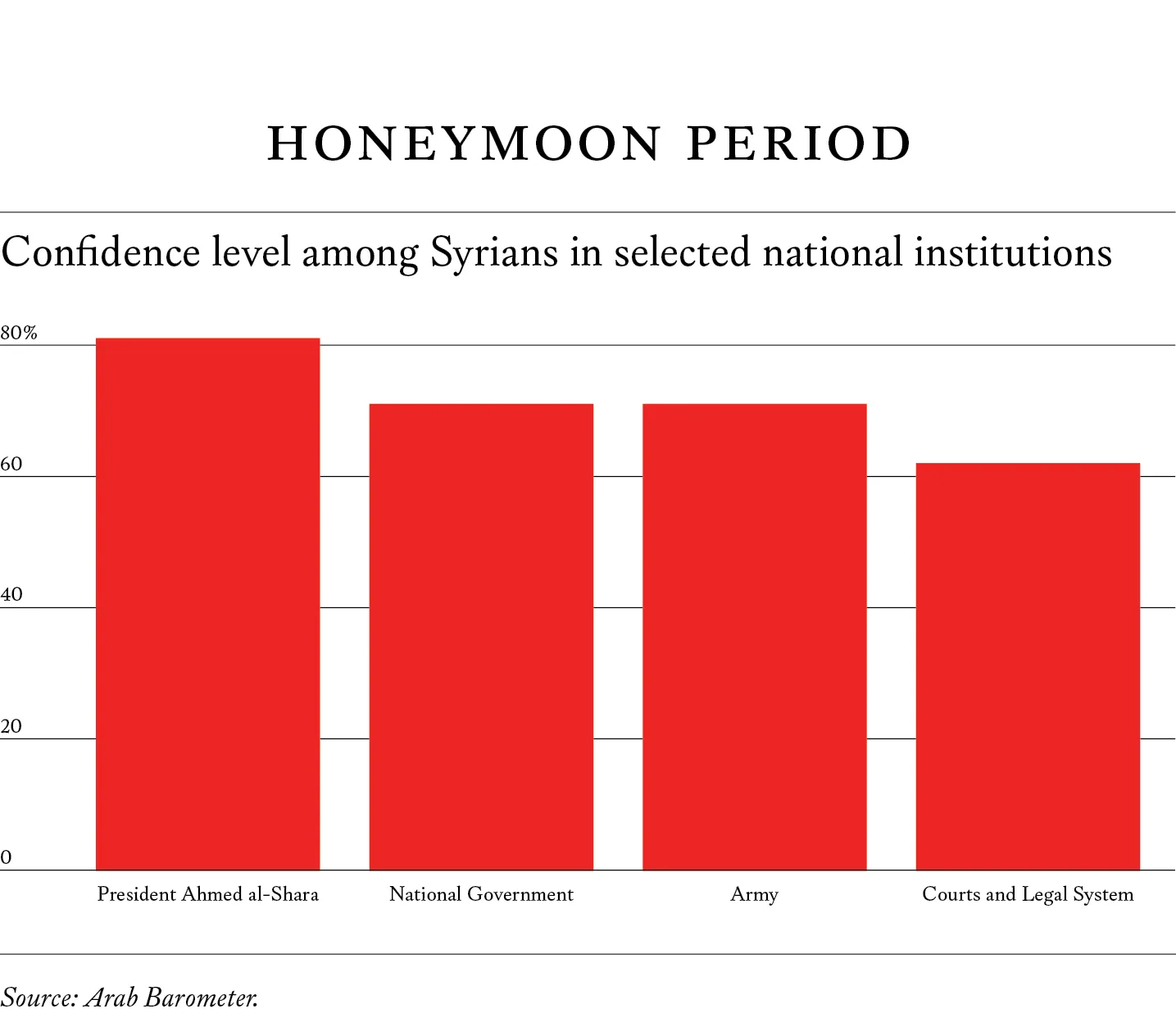
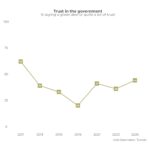
- High confidence across institutions: president 81%, national government 71%, army 71%, national security forces 84%, and courts 62%.
- Freedoms broadly viewed as guaranteed: speech 73% and press 73%, but notably freedom to demonstrate peacefully lags slightly behind at 65%.
- Strong perceptions of government responsiveness: 67% believe the government responds to citizens’ needs.
- Striking optimism for the future: although 50% say their lives are worse than their parents’, 76% expect their children’s lives to be better; 76% view President Al-Sharaa’s policies as better than Assad’s.
- Sharp decline in personal hardship: 78% experienced major disruptions between 2011–2024 (displacement, property loss, disrupted livelihoods or education, family deaths, or political intimidation), dropping to 14% after 2024.
An Economy Under Strain: Syria’s Urgent Post-Transition Challenge
Widespread poverty, food insecurity, and failing public services continue to shape daily life in Syria, highlighting the scale of the economic challenge for the country’s new leadership.
- Economic hardship dominates daily life: Only 17% rate the economy positively; top concerns are inflation (31%), job scarcity (24%), and poverty (23%).
- Earnings fail to meet needs: 86% say their household income does not cover expenses, and 56% cite meeting basic needs as their primary challenge.
- Food insecurity is widespread: nearly half of Syrians and 73% of internally displaced persons report often or sometimes running out of food before having money to buy more in the past 30 days, with 79% citing lack of money and 82% high prices as the main barriers.
- Dissatisfaction with de facto authorities is high on job creation (77%), wages (58%), and socioeconomic inequality (68%).
- Infrastructure satisfaction remains low: trash collection (46%), internet access (43%), electricity (41%), healthcare (36%), affordable housing (35%), and water supply (32%).
Democratic Aspirations: Testing Governance in Fragile Times
Syrians overwhelmingly support democracy but emphasize security, fair political processes, and more inclusive governance.
- Security concerns: Securing a monopoly over the use of force is seen as country’s second biggest challenge after the economy. 74% want weapons collected from armed groups, 78% from unauthorized individuals, and 63% see kidnapping as a critical threat.
- Local safety and governance satisfaction: Nearly all Syrians (94%) report feeling safe in their neighborhoods, and 85% are satisfied with local authorities’ efforts to maintain order.
- Democracy preferred: Most still see Syria as closer to a non-democracy than a democracy, yet they insist democracy is an appropriate system for the country.
- Strong support for democratic principles: 70% say democracy is preferable despite its problems; fewer than half (43%) support a leader who bends rules to achieve results.
- Political process confidence: Confidence in the newly elected People’s Council is moderate at 53%, and only 40% say the election process was clearly explained and provided equal opportunities for candidacy.
Uneven Ground: Regional Gaps Reveal Challenges to Syrian Unity
While national optimism runs high, violence-affected, minority-heavy areas remain skeptical, revealing persistent hurdles to social cohesion and an uneven post-Assad transition.
- In Suwayda, Latakia, and Tartus, confidence in institutions is far below national levels: president 36%, government 36%, courts 33%, army 22%, security forces 53%.
- Syrians in these governorates perceive fewer personal freedoms: speech 31%, press 34%, assembly 16%; only 35% say the government responds to their needs (vs. 67% nationally).
- Broader social challenges persist across Syria: 78% see intolerance as a societal problem; 41% cite “accepting others and rejecting sectarianism” as the key lesson from 2011–2024.
- Barriers to unity include events 2011–2024 (88%), political differences (73%), class inequality (65%), events after 2024 (64%), and sectarianism (59%).
Transitional Justice: Accountability vs. Reconciliation
Syrians back broader transitional justice measures, highlighting the delicate path toward healing deep wounds while preventing cycles of revenge.
- Prosecution prioritized: 49% say holding perpetrators accountable is the main goal, while 27% emphasize establishing the truth about crimes.
- Expand the mandate: 70% (81% among minorities) want the National Commission to cover crimes by all armed actors, not just Assad’s regime.
- Shared need for safety and representation: About half of Syrians say both majority and minority groups equally need safety (53%), political representation (55%), and respect for their political preferences (51%), with the majority generally self-identifying as Sunni Arabs and minorities generally self-identifying as Alawites, Armenians, Christians, Druze, Kurds, Turkmen, and others.
- Acknowledging injustices remains contested: While a plurality of Syrians say both majority and minority groups should have pre-2024 (40%) and post-2024 (31%) injustices recognized, sizable shares prioritize one group—38% the majority for pre-2024, 29% minorities for post-2024—highlighting the urgent need for a transitional justice system that serves all Syrians.
- Extralegal justice widely rejected: Only 9% of Syrians say justice outside formal institutions is fairer, and 19% say it is faster.
Syria Looks Abroad: Openness to Foreign Aid
Syrians are open to Western aid while wary of former Assad allies, reflecting a pragmatic approach to foreign relations amid national reconstruction—though concerns over Israel remain near-universal.
- Aid priorities: Syrians want foreign assistance focused on economic development (45%) and infrastructure rebuilding (36%).
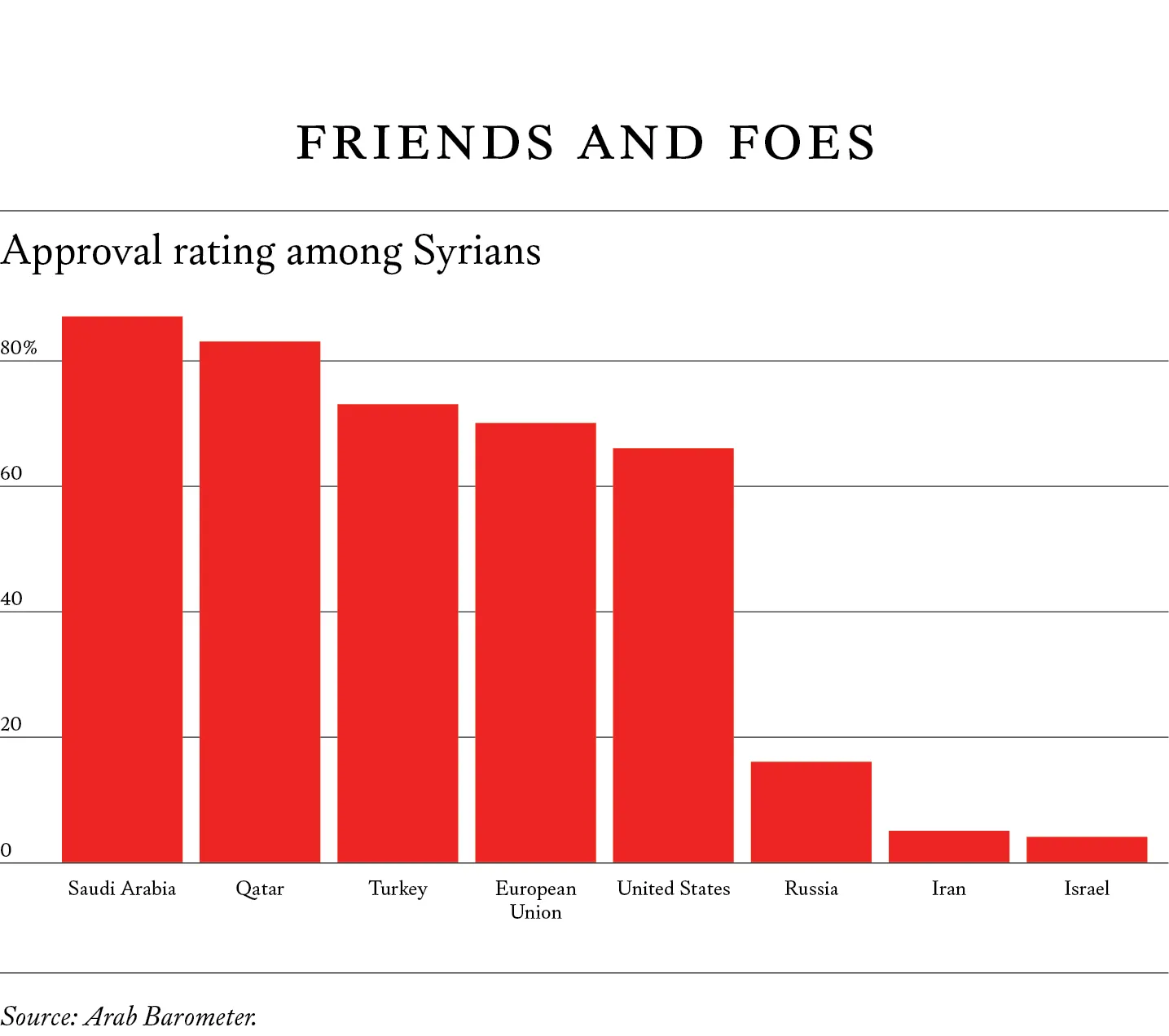
- Favorable partners: Saudi Arabia (87%), Qatar (83%), Turkey (73%), EU (70%), and the US (66%) are viewed positively. Unlike much of the Arab world, Syrians’ support for the U.S. does not appear constrained by its association with Israel.
- Donald Trump’s record: 61% view him favorably, and nearly half say his policies were better than his predecessor’s, likely due to sanction relief.
- Israel seen as a top threat: 92% see Israel’s occupation of Palestinian territories and strikes on Syria, Iran, and Lebanon as critical threats; only 14% support normalization. Israel is also widely disfavored (4%).
- Disfavored powers: Syrians reject Assad-aligned Iran (5%) and Russia (16%) and also Israel (4%), while China receives only moderate support (37%), far below most MENA countries.
How we did this?
Check out our Syria methodology
Please credit Arab Barometer in any dissemination.
ENDS //
Interview Opportunity
Salma Al-Shami, Director of Research, and Michael Robbins, Director of Arab Barometer and co-principal investigator, are the authors of the Foreign Affairs article and are available for interviews to provide context, discuss the data, and explore implications for Syria’s political and economic trajectory.
For media inquiries, please contact Aseel Alayli, Director of Brand, Marketing, and Global Communications, at aalayli@princeton.edu.