 There are many contenders, but Turkey’s president leads the pack
Whether speaking to a small group or a mass rally, Recep Tayyip Erdogan, Turkey’s president, often appears to have a bigger audience in mind than the people right in front of him. A talk he gave in mid-February, on the eve of Ramadan, the Muslim holy month, seemed addressed in parts not to the 80 provincial governors who had convened at his palace in Ankara, but to the world’s nearly 2bn Muslims. “May the umma not be crushed by the divisions that have lasted for ages,” he said, referring to the global community of Muslims. “If only we cling tightly to our brotherhood, to our brothers, to our faith and to our dreams, then, by the permission of Allah, there will be no trap we cannot break.”
The umma has no spokesperson. Since the death of the Prophet Muhammad in 632, the Muslim world has not had an undisputed leader or paramount religious authority. Like Buddhism or Christianity, it is divided not only into many nationalities, but also many sects. Most Muslims do not share a common language, even though many learn the Koran in Arabic. Mr Erdogan was speaking Turkish—a language understood by only a small sliver of Muslims. The idea that an “imagined Muslim public” is clamouring for someone to speak on its behalf is a fiction, says Cemil Aydin of the University of North Carolina.
Testing, testing
Yet a few politicians seem to be auditioning for the job. Mr Erdogan has gained a following abroad, and appealed to devout voters at home, by taking up the cause of downtrodden Muslims around the world. Iran’s supreme leader, Ayatollah Ali Khamenei, goes further, casting himself as a leader of resistance to the oppression of Muslims. Others, such as Muhammad bin Salman, Saudi Arabia’s crown prince, emphasise modernity and moderation, rather than religious zeal. All have their followings—and their detractors. But new survey data from Arab Barometer, a research network, and other polling, suggest that Mr Erdogan’s approach is the most appealing to Muslims around the world.
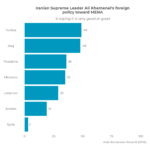
Mr Khamenei often casts today’s struggles in sacred hues. As an Americanarmada massed off Iran’s shores, he wore a ring to a scriptural study groupinscribed with a Koranic verse recalling Moses’s deliverance from the mightyPharaoh and the drowning of the vast and godless Egyptian army in the Red Sea.But Mr Khamenei, a Shia, has relatively little influence among Sunnis, who makeup between 85% and 90% of the world’s Muslims. What is more, the Iranianregime’s frequent, violent repression of protests at home has diminished hisappeal. Even fellow Shias, in countries like Lebanon and Iraq, seem to be coolingon the ageing ayatollah.
Some Sunnis see Ahmed al-Sharaa, Syria’s rebel-leader-turned-president, as amore credible defender of their faith. He led an Islamist insurgency against thelargely secular regime of Bashar al-Assad, so his religious convictions are not indoubt. In fact, by overthrowing a regime backed by Shia Iran and by defeatingmilitias representing minority sects such as Alawites and Druze, Mr Sharaa hasdelighted many in Syria’s Sunni majority. Lots of Sunnis in Lebanon and Iraq,who worry their Shia compatriots will sideline them politically, are also thrilled byhis success. According to unpublished recent polling, Mr Sharaa commands broadsupport in Jordan and Saudi Arabia as well…
Read the full article at The Economist