News broke on Tuesday, February 3, 2026, that Seif al-Islam Gaddafi was killed at his residence in western Libya. While his death marks the end of a controversial figure, its political significance may lie less in the event itself than in how Libyans perceive him—and what his absence means for the future of Libya’s fragmented political landscape.
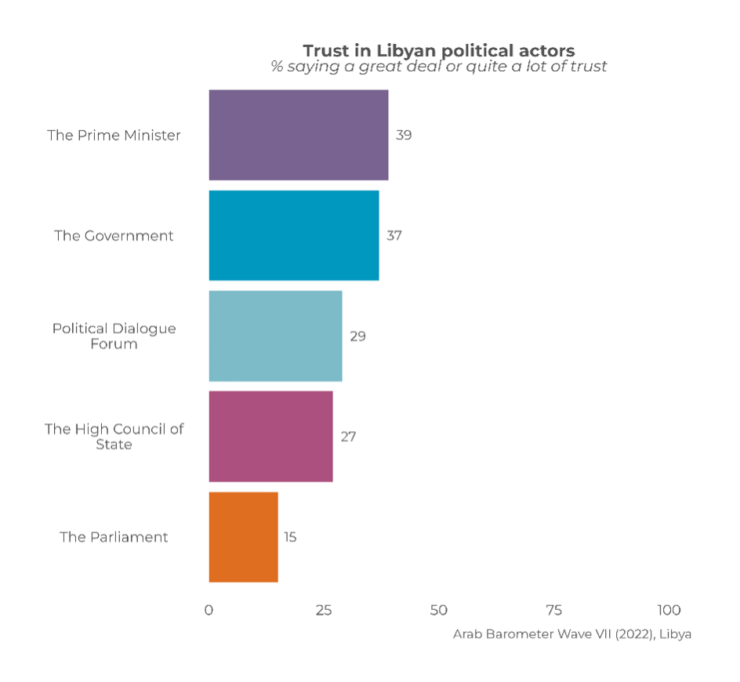
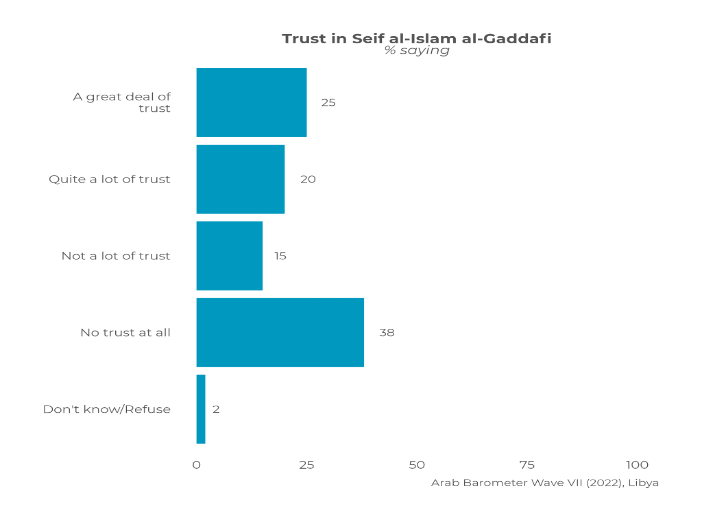
According to Arab Barometer’s Wave VII survey in Libya (2022), Seif al-Islam retained an unusually high level of public support for a controversial figure: 45 percent of Libyans said they had a “great deal” or “quite a lot” of trust in him. By comparison, only 39 percent expressed similar trust in Abdulhamid Dbeiba, the Prime Minister of the Government of National Unity and one of Seif’s principal rivals. This indicates that, despite his divisive past, Seif al-Islam occupied a unique place in the Libyan public’s political landscape.
Seif al-Islam was the most prominent of Muammar Gaddafi’s sons and, in the years preceding the 2011 uprising, was widely viewed as the heir apparent to his father, who ruled Libya from 1969 until his overthrow in 2011.When protests erupted across Libya in February 2011, Seif al-Islam firmly aligned himself with the regime, playing a visible role in the crackdown on demonstrators and in the ensuing armed conflict. His involvement led the International Criminal Court to issue an arrest warrant for him in June 2011. After Muammar Gaddafi’s death later that year, Seif al-Islam went into hiding before resurfacing sporadically, most notably in 2021, when he announced his candidacy for Libya’s long-delayed presidential elections. When the elections were postponed indefinitely, he again faded from the public eye.
Public Opinion Matters
Seif al-Islam’s reported death comes at a moment when Libya’s political scene has long been marked by stagnation, uncertainty, and institutional deadlock. Arab Barometer latest available survey in Libya, conducted in 2022, indicates that public trust in political institutions and figures is highly fragmented. How Libyans respond in the coming months could influence the trajectory of Libya’s politics for years to come.